

6 Best LatePoint Alternatives for WordPress in 2026 — Tested & Compared

If you are weighing LatePoint for a WordPress appointment booking workflow — or already running it and quietly wondering whether the multilingual gap, the missing native mobile app, or the lack of chart-based reporting is going to bite once your business grows — the real question is which other plugins actually answer the reasons you are second-guessing the choice in the first place. LatePoint is one of the more polished WordPress booking plugins on the market in 2026, with a real freemium WordPress.org listing (100,000+ active installs, 4.9/5), an isolated SaaS-style admin that hides the standard WordPress chrome on every screen, a live-preview Booking Form customizer with drag-to-reorder steps, and an all-features-in-every-paid-plan licensing model that removes the per-add-on math common in this category. But it is also a plugin that ships only a small set of bundled locales (broader multilingual coverage is a long-standing open feature request on the company's ideas board), where the free tier is heavily restricted (Stripe-only payments, no Google Calendar 2-way sync, no customer dashboard, no recurring appointments, no OTP), and where there is no native iOS or Android mobile app, no white-label / backend rebrand, no chart-based reporting module, and no built-in events module with QR-coded e-tickets at any tier. Those are the situations that send most readers down a LatePoint-alternative search.
To answer that, I tested six of the most relevant LatePoint alternatives across licensed environments, hosted sandboxes, and full-feature trials, then walked the front-end booking flow end-to-end on each one. I cross-checked live pricing pages, sampled rating patterns from WordPress.org, CodeCanyon, Capterra, and Trustpilot, and read recent Reddit and WordPress community threads to ground the ranking in real-user context — not marketing copy. The shortlist below leans on the same hands-on evidence that informed the cluster's product reviews; nothing here is sourced from outside that evidence base.
This is a hands-on editorial guide, not a vendor comparison page. If you only need the headline pick, scroll to the quick comparison table; if you want the reasoning, the full ranked list is below.
Why Look for a LatePoint Alternative?
LatePoint is a legitimate option for most solo professionals and small WordPress service businesses — the front-end widget converts cleanly, the Appointment Confirmed page surfaces Add to Calendar, Print, and Show QR buttons, the Automation module ships a visual workflow builder out of the box, and the all-features-in-every-paid-plan licensing means you do not have to assemble add-ons one by one. The full hands-on LatePoint review walks through the product in detail. But there are four to five practical reasons buyers shortlist alternatives before they commit, and each one is worth taking seriously.
Heavily restricted free tier. The WordPress.org free plugin ships with only Stripe payments, no Google Calendar 2-way sync, no customer dashboard, no recurring appointments, no OTP verification, and no Zoom / Google Meet / WhatsApp / SMS — most production sites have to upgrade to Starter ($79/yr or $199 lifetime) to unlock these. Negative Trustpilot threads also flag misleading free-tier marketing where Google Calendar and OTP are advertised but turn out to be Pro-only. Buyers who want a free tier they can run a real one-off business on, or a free tier with broader payment-gateway coverage, specifically shortlist alternatives.
Limited multilingual coverage. LatePoint ships with only a small set of bundled locales in the free plugin, and broader multilingual support remains a long-standing open feature request on the company's ideas board. There is no built-in visual translator at any tier. Buyers who serve multilingual markets — clinics, multi-country agencies, language-dependent service businesses — specifically look for alternatives with stronger out-of-the-box language coverage.
No white-label / backend rebrand option and no native mobile app. LatePoint does not currently offer a white-label / backend rebrand, so agencies cannot deploy under a client brand without LatePoint chrome showing on every admin screen. There is also no native iOS or Android mobile app for staff or admins — all admin and staff work runs through the browser. Multi-location service businesses where staff move between rooms or sites, and agencies deploying for clients who want a branded admin, specifically look for alternatives that fix one or both gaps.
No chart-based reporting module. Reports are functional — searchable, sortable, filterable datatables and CSV export work as expected — but LatePoint does not ship a chart-based revenue, appointment, or staff-utilization dashboard. Operators who want a graphical at-a-glance view shortlist alternatives whose reporting module is more visual.
No built-in events module with QR-coded e-tickets. This is the recurring negative on Reddit / r/WordPress and community comparison sites — weak event-booking support at any LatePoint tier. There is no one-time / recurring events module, no multiple ticket tiers, no waiting list, and no QR-coded e-ticket flow. If your business sells appointments and ticketed events from the same site, LatePoint is not the right pick alone.
Multisite licensing rule. A separate license is required per WordPress sub-site within a multisite network — the rule is documented on the latepoint.com site count page and flagged in community comparisons (presscompare.com, wpbookster.com). Network operators who want one license to cover every sub-site shortlist alternatives whose multisite policy is friendlier.
These are real reasons, not unfair attacks. None of them mean LatePoint is the wrong choice — they mean alternatives exist that fit some buyer profiles better.
Quick Comparison: Best LatePoint Alternatives
If you only have time for the shortlist, here are the six alternatives I would compare against LatePoint, with the one-line reason each one earns its place.
| Alternative | Best for | Starting price | Free version / trial | Strongest reason to choose it over LatePoint | Main limitation | Full review |
|---|---|---|---|---|---|---|
Booknetic | Multi-staff and multi-location WordPress service businesses that want native mobile, white-label, multilingual, and graphical reports | $45/ | No published free version; 14-day money-back on paid plans | Native iOS/ | No published free version; payments / calendar sync / video meetings / SMS / white-labeling are paid Boostore add-ons | |
Amelia | Service businesses and event organizers that want a polished admin and a built-in events module with QR e-tickets | Free Lite on WordPress.org; paid plans from $49/ | Yes — free Lite on WordPress.org; 15-day money-back on paid plans | Built-in Events module with one-time and recurring events, multiple ticket tiers, waiting lists, and QR-coded e-tickets — the LatePoint events gap | Plan-tier gating still pushes most production sites to Pro for Google Calendar, video meetings, and Events | |
BookingPress | WordPress service businesses that need broad payment gateway coverage in one bundled plan | Free Lite (unlimited sites); Standard from $89/ | Yes — Lite plan with unlimited sites; 14-day money-back | 20+ payment gateways spanning global and regional providers (Razorpay, Mercado Pago, Paystack, PayMongo, Klarna), bundled into every paid plan | Not currently distributed through WordPress.org; plan-tier gating on Recurring Appointments, Multi-Staff Bookings, POS, REST API | |
Bookly Pro | WordPress-savvy buyers who want the longest WP.org track record and a perpetual lifetime license | Free base plugin on WP.org; Pro from $49/ | Yes — real free Bookly on WP.org since 2014; 30-day money-back | More than a decade on WordPress.org and the largest paid-review footprint in the category (1,173+ on CodeCanyon) | Per-add-on math is the opposite of LatePoint's bundled licensing; older admin UI | |
FluentBooking | Coaches, consultants, and sales teams that want a Calendly alternative inside WordPress | Free WP.org plugin; Pro Solo from $79/ | Yes — real free WP.org plugin; 14-day money-back | Calendly-style scheduler with the same all-features-in-every-paid-plan logic as LatePoint, plus deep FluentCRM hooks | Not built for multi-staff multi-location service-business workflows; narrower payment gateway list | |
Simply Schedule Appointments | Solo consultants and small service teams running one WordPress site | Free Basic on WP.org; Plus from $99/ | Yes — real free Basic on WP.org; 30-day money-back | Highest WordPress.org rating in this set (5/ | Single-site annual licensing; only Stripe + PayPal as payment gateways; no events module |
The full ranking, including the reasoning behind each placement, is below.
1. Booknetic
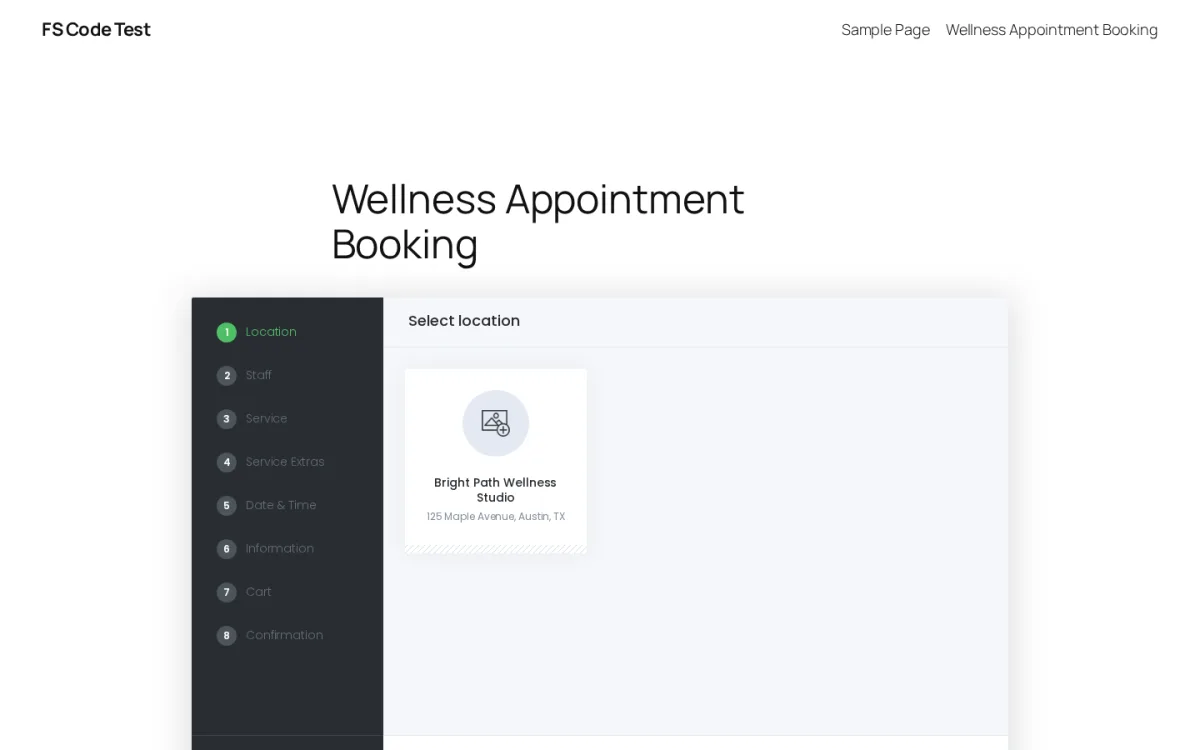
Best for: Multi-staff and multi-location WordPress service businesses that match the LatePoint profile but need a native mobile app, white-label backend, broader multilingual coverage, and a graphical revenue dashboard.
In hands-on testing, Booknetic is the cleanest direct answer to the specific reasons most buyers leave LatePoint, and the one the LatePoint review itself names as the closest direct alternative. I tested Booknetic 5.2.6 on a fresh WordPress 6.9.4 environment with the full Boostore add-on suite enabled and submitted a complete frontend booking (Priya Shah → Bright Path Wellness Studio → Initial Wellness Consultation, $85.00) end-to-end. The booking landed cleanly in the admin Calendar, the Appointments datatable, the Customers list, and the Dashboard counters, and the Workflow + Boostore combination gives Booknetic feature depth that closes most of LatePoint's open gaps in one place.
Why it is a strong alternative to LatePoint: Four reasons map directly to LatePoint's biggest pain points. First, Booknetic ships a native iOS and Android mobile app for staff and admins — LatePoint does not advertise a mobile app at any tier. Second, it ships a white-label / backend rebrand option, so agencies can deploy under a client brand without booking-plugin chrome showing — another LatePoint gap at every tier. Third, the multilingual coverage is broader (built-in admin translator and stronger out-of-the-box locales), which is the single most-cited LatePoint negative on Reddit / community sources. Fourth, the admin Dashboard surfaces a real graphical revenue chart plus stat cards (appointments, total duration, revenue, new customers) — a direct counter to LatePoint's missing chart-based reporting module. Amelia is the natural pick when paid events with QR-coded e-tickets are central to the operation, since it bundles the events module with QR-coded e-tickets directly inside one plugin. For the head-to-head decision, see the Booknetic vs LatePoint breakdown.
What stood out in testing: The dedicated SaaS-style admin panel hides the standard WordPress chrome while you are inside it, which is the same admin-polish move LatePoint makes — both plugins are above the WordPress booking-plugin baseline on day-to-day UX. The frontend wizard renders Location → Staff → Service → Service Extras → Date & Time → Information → Cart → Confirmation with a clear step strip, the Service Extras step auto-skips when no extras are configured, and the admin Calendar (Month / Week / Day / List) supports drag-and-drop rescheduling. Workflow is Booknetic's "when X happens → do Y" engine and maps booking events (created, approved, rescheduled, completed, cancelled) to actions like email, SMS, WhatsApp, Telegram, webhook, or Mailchimp — comparable depth to LatePoint's Automation module and slightly broader on third-party destinations.
Main strengths:
- Native iOS and Android mobile app for staff and admins (LatePoint gap at every tier).
- White-label / backend rebrand option for agencies (LatePoint gap at every tier).
- Stronger multilingual coverage with a built-in translator UI (LatePoint gap).
- Graphical revenue dashboard with stat cards (LatePoint gap).
- Strongest public rating profile in the category (CodeCanyon 4.91/5 from 471 reviews; Capterra 4.5/5).
Main limitations:
- No published free version on the main pricing page — paid plans are the practical entry point. LatePoint's free WordPress.org tier is genuinely broader at the introductory level.
- Payments, calendar sync, video meetings, SMS, and white labeling are paid Boostore add-ons — different model from LatePoint's bundled paid plans.
- Basic plan ships with zero paid add-ons, so most buyers will need Standard or higher to match what LatePoint Starter delivers.
- Trustpilot rating sits at 3.4/5 from 21 reviews — lower than LatePoint's 4.8/5 — even though CodeCanyon and Capterra are strong.
Pricing snapshot: Basic $45/yr or $99 lifetime (no paid add-ons); Standard $99/yr or $239 lifetime (8 paid add-ons of your choice); Premium $199/yr or $599 lifetime (19 paid add-ons); Elite $299/yr or $899 lifetime (all 50+ paid add-ons included). 14-day money-back guarantee. Public ratings: CodeCanyon 4.91/5 (471 reviews); Capterra 4.5/5 (103 reviews); Trustpilot 3.4/5 (21 reviews).
Read the full review: Booknetic review
2. Amelia
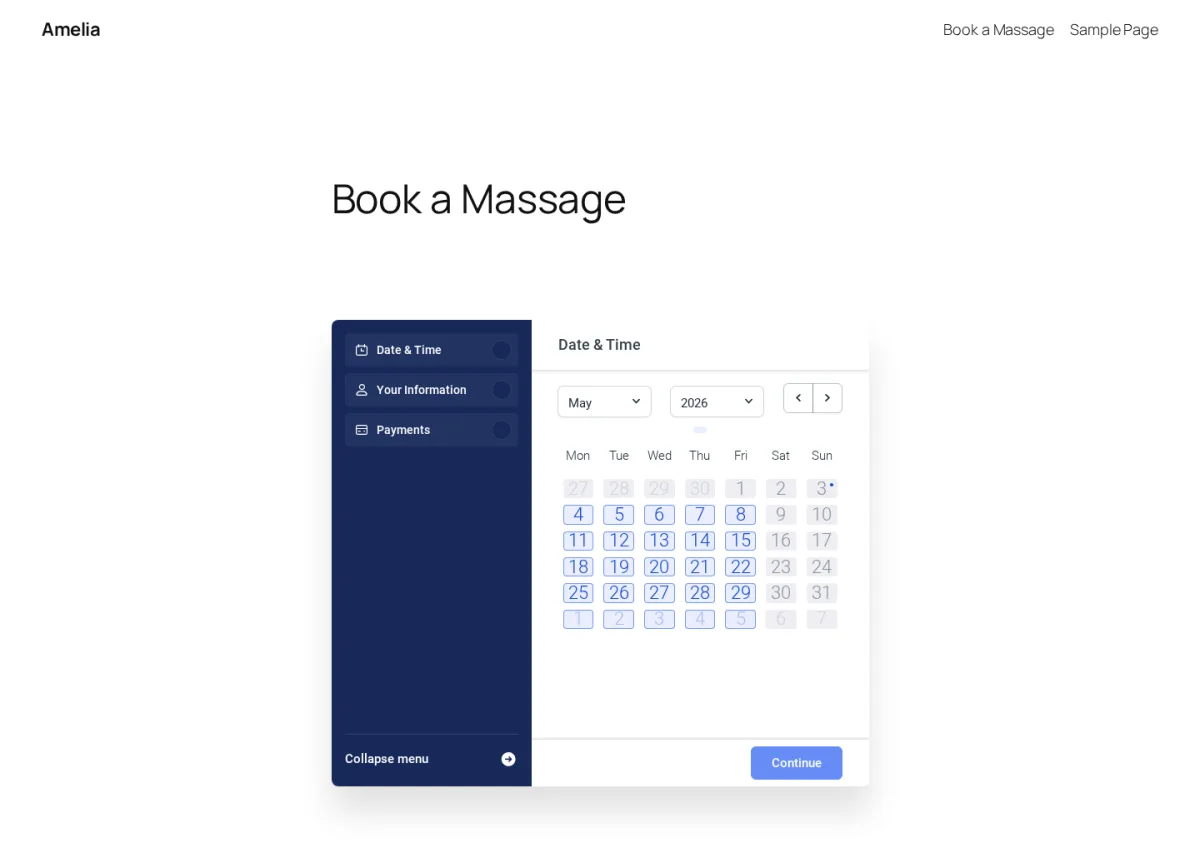
Best for: Service businesses and event organizers that want a polished admin, a real WP.org Lite plugin, and a built-in events module LatePoint does not ship.
Amelia is the alternative to pick when the LatePoint dealbreaker is the missing events-with-tickets module. In testing on a licensed WordPress 6.9.4 install, I started from a completely empty environment, created a Location, an Employee, and a paid Service from scratch, then walked the public widget through Date & Time → Your Information → Payments end-to-end. The booking landed cleanly in Bookings, on the Calendar, and on the Customers list, and the dashboard counters updated as expected.
Why it is a strong alternative to LatePoint: Three reasons. First, Amelia is the only plugin in this entire shortlist that ships a built-in events module with one-time and recurring events, multiple ticket tiers (VIP / General / Early Bird), waiting lists, and QR-coded e-tickets attached to confirmation emails. If your business sells appointments and ticketed events from the same site, Amelia closes that LatePoint gap inside one plugin instead of forcing a separate event platform. Second, the Customize hub is a dedicated branding surface with six live-preview editors (Step-by-step, Catalog, Events calendar, Events list, Customer panel, Employee panel) — broader than LatePoint's single Booking Form customizer. Third, Amelia has the highest Capterra rating in this set (4.9/5 from 240+ reviews), and the deep Notifications module — Email and SMS tabs with To Customer / To Employee sub-tabs and placeholder pills — gives commercial sites a more complete out-of-the-box messaging surface than LatePoint does on the lower-priced tiers. For the head-to-head decision, see the Amelia vs LatePoint breakdown.
What stood out in testing: The Notifications module is one of the deepest in the category. It exposes a long event list (Approved, Pending, Rejected, Cancelled, Rescheduled, Reminders, Follow-up, plus dedicated Events templates with E-ticket), and the template editor uses placeholder pills for Appointment / Customer / Employee / Service / Location / Company / Payment, which is safer than typing raw shortcodes. Picking a date instantly revealed a 30-minute slot strip for the assigned employee, and the chosen slot showed up in the side menu before I had to confirm — small details that lift Amelia above the WordPress booking-plugin baseline. The free Lite plugin on WordPress.org (760+ reviews, 4.6/5) gives buyers a real WP.org evaluation path that mirrors LatePoint's free-tier model but with a different feature mix.
Main strengths:
- Built-in Events module with QR-coded e-tickets — the rare differentiator LatePoint does not ship at any tier.
- Customize hub with live preview across six surfaces — broader than LatePoint's single Booking Form customizer.
- Deep notifications matrix across email, SMS, and WhatsApp with per-event templates.
- Highest Capterra rating in this set (4.9/5 across 240+ reviews); real free Lite plugin on WordPress.org.
Main limitations:
- Plan-tier gating still pushes most production sites onto Pro at $149/yr to unlock Google Calendar / Apple Calendar two-way sync, Zoom / Google Meet / MS Teams, and the Events module — so the bundled story is partial, not LatePoint-style total.
- Trustpilot reputation tail (3.6/5 across 230+ reviews) sits below LatePoint's 4.8/5 in the wake of the v9 launch window.
- No native mobile app for staff or admins — same gap as LatePoint.
- Empty default state with a couple of unintuitive setup quirks (Employee silently requires a Location to save), so the day-one experience is less smooth than LatePoint's published "10-minute setup" claim.
Pricing snapshot: Free Lite on WordPress.org; Starter from $49/yr; Standard from $89/yr or $299 lifetime; Pro from $149/yr or $449 lifetime; Elite from $259/yr or $799 lifetime. 15-day money-back guarantee. Public ratings: WordPress.org 4.6/5 from 760+ reviews; Capterra 4.9/5 from 240+ reviews; Trustpilot 3.6/5 from 230+ reviews.
Read the full review: Amelia review
3. BookingPress
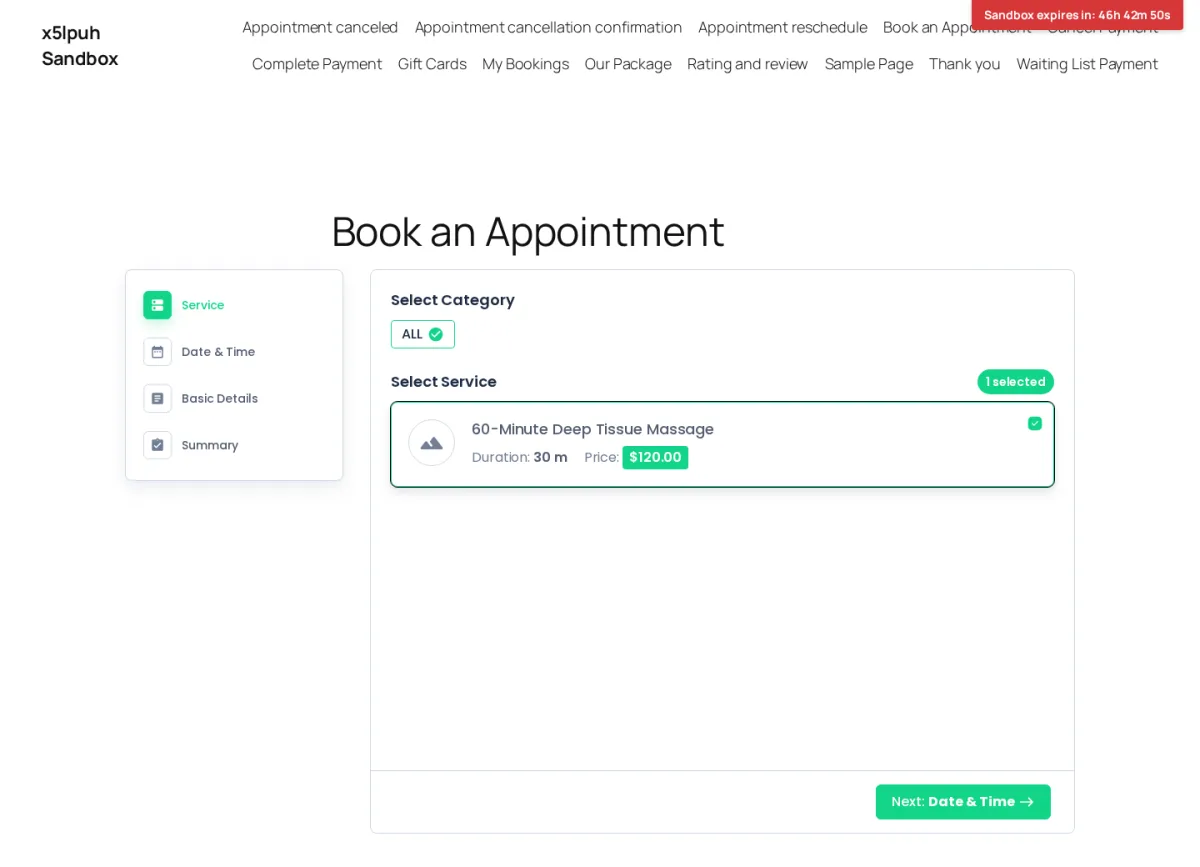
Best for: WordPress service businesses that need broad payment gateway coverage — especially regional providers — bundled into one paid plan.
BookingPress is the alternative to pick when the dealbreaker is LatePoint's narrower Add-ons catalogue on payment gateways. In testing on the official BookingPress sandbox with the full paid add-on catalog enabled, I configured a $120 60-minute deep-tissue massage service, walked the booking widget through Service → Date & Time → Basic Details → Summary, and the post-submit confirmation page surfaced the Booking ID inline with four Add-to-Calendar shortcuts (Google, Yahoo, Outlook, iCal) — a slightly richer confirmation surface than LatePoint's Order code + Add to Calendar / Print / Show QR set.
Why it is a strong alternative to LatePoint: Two reasons. First, BookingPress's payment gateway list is unusually broad — 20+ providers spanning Stripe, PayPal, Mollie, Square, Braintree, Worldpay, Skrill, Klarna, Paddle, 2Checkout, Authorize.net, WooCommerce, plus regional options like Razorpay, PayUMoney, Paystack, PayFast, Pagseguro, Mercado Pago, ECPay, PayMongo, and Airwallex. LatePoint's Add-ons catalogue covers the major global gateways (PayPal, Square, Mollie, Razorpay, Paystack, Flutterwave, Mercado Pago, Braintree, SureCart, WooCommerce) but is narrower on the regional long tail (no PayMongo, no Airwallex, no ECPay, no Pagseguro, no Worldpay). Operators in markets where regional gateways matter often find BookingPress's bundled coverage closes a real commercial gap. Second, the Free Lite plan allows unlimited websites, which is broader than LatePoint's single-site free tier — useful for agencies running due-diligence across multiple client sites. For the head-to-head decision, see the BookingPress vs LatePoint breakdown.
What stood out in testing: The Customize module is where the admin feels genuinely modern. Four tabs (Booking Form / Customer Panel / Package Booking / Gift Card) each render a live preview alongside font, color, and step-order controls, and you can drag-and-drop reorder the booking steps — the closest in this set to LatePoint's live-preview Booking Form customizer with drag-to-reorder steps, and slightly broader because it covers four surfaces instead of one. For a non-developer who wants a branded widget without writing CSS, this is one of the strongest day-to-day usability advantages BookingPress offers.
Main strengths:
- 20+ payment gateways across global and regional providers, all bundled into every paid plan — broader than LatePoint's Add-ons catalogue.
- Free Lite tier with unlimited websites — broader than LatePoint's single-site free tier.
- Customize module covers four surfaces (Booking Form, Customer Panel, Package Booking, Gift Card) — broader than LatePoint's single Booking Form customizer.
- Booking confirmation page includes Booking ID and Add-to-Calendar shortcuts inline.
Main limitations:
- Not currently distributed through WordPress.org; install and updates run through bookingpressplugin.com — the opposite of LatePoint's WP.org-first distribution.
- Plan-tier gating: Recurring Appointments, Multi-Staff Bookings, Service Package, Location, Advanced Discount, Gift Card sit on Professional or Enterprise; the POS Addon, Roles & Capabilities, and the REST API are Enterprise-only. LatePoint's bundled paid plans do not have this kind of gating.
- Validation rough edges around the Location and Staff Member add-ons make the first hour of setup frustrating for non-technical admins — LatePoint's day-one experience is smoother.
- Reporting is functional but visually thin — no graphical breakdown by staff or location, the same gap LatePoint has.
Pricing snapshot: Free Lite (unlimited sites); Standard $89/yr or $229 lifetime (1 site); Professional $139/yr or $379 lifetime (3 sites); Enterprise $249/yr or $599 lifetime (20 sites). 14-day money-back guarantee. Public ratings: WordPress.org 4.6/5 from 175 archived reviews; Capterra 4.5/5 from ~71 reviews; Trustpilot 4.3/5 from ~81 reviews.
Read the full review: BookingPress review
4. Bookly Pro
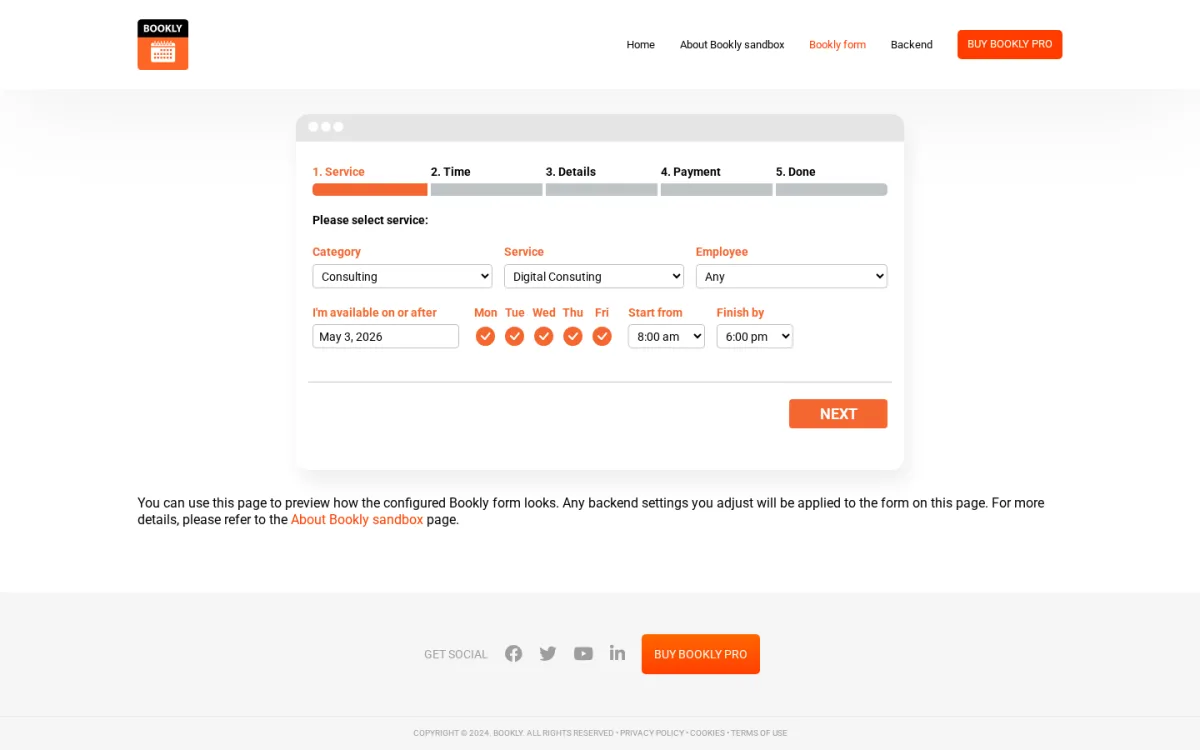
Best for: WordPress-savvy buyers who weight market track record and a perpetual lifetime license over admin polish.
Bookly Pro is the alternative to pick when track record and reviewer depth weigh more heavily than admin polish. The free Bookly plugin has been on WordPress.org since October 2014 — the longest WP.org track record in this entire set — and the paid Pro extension has 1,173+ paid reviews on CodeCanyon, the largest paid-review footprint in the category. In testing on the official Bookly sandbox with the Pro license plus 40+ paid add-ons activated, I committed a $540 Digital Consulting booking on the front-end and the booking landed in admin Appointments, Calendar, Customers, and Dashboard exactly as expected.
Why it is a strong alternative to LatePoint: Two reasons. First, the WordPress.org free tier is genuinely usable for due-diligence — 1 staff member, up to 5 services, basic email + SMS templates, and Local payment — which is a different shape of free tier from LatePoint's (LatePoint allows multiple agents and services on free, while Bookly's free tier allows 1 staff member but is older and more battle-tested), and the long-running CodeCanyon paid-review footprint gives subscription-averse buyers the deepest reputational evidence in the category. Second, the Lifetime tier on the official site is the same one-time, perpetual license historically distributed on CodeCanyon — Pro Lifetime $129, Business Lifetime $399, Ultimate Lifetime $799 — so subscription-averse buyers can avoid annual renewals entirely. LatePoint also offers lifetime SKUs, but Bookly's lifetime model is dramatically older and has a longer reputational tail.
What stood out in testing: Picking Consulting filtered the service dropdown, choosing Digital Consulting auto-loaded staff Nick Knight, and the Time step rolled out a multi-day grid of 15-minute slots grouped by day for the selected staff member. Clicking a slot advanced the wizard immediately and printed a clear handover line confirming the service, staff, date, and price ("$540.00") before the Details step — a small but useful conversion moment. The Add-ons page is where Bookly's economy lives; it covers payment gateways (Stripe, Mollie, PayPal Standard, Authorize.Net), calendar sync (Advanced Google Calendar two-way, Outlook), scheduling extensions (Recurring Appointments, Group Booking, Waiting List), commerce (Coupons, Taxes, Invoices, Deposit Payments, Packages), and ops (Locations, Staff Cabinet, Customer Cabinet, Custom Fields). The same modules are bundled together at a discount inside the Business and Ultimate plans. The Email Notifications module on Pro is also one of the strongest non-widget modules in the category — granular per-event, per-recipient templates with reminders, follow-ups, evening agendas, and birthday greetings.
Main strengths:
- Genuine free tier on WordPress.org since October 2014 — longest market track record in this set.
- 1,173+ paid reviews on CodeCanyon — the largest paid-review footprint in the category.
- Lifetime tier on the official site is the same one-time, perpetual license historically distributed on CodeCanyon — only the Annual tier renews.
- Strong Email Notifications module on Pro with reminder, follow-up, agenda, and birthday templates.
Main limitations:
- The most commercially important capabilities — Stripe, two-way Google Calendar, recurring appointments, locations, custom fields, customer/staff portals — sit in paid add-ons rather than the Pro plan, which is the opposite of LatePoint's all-features-in-every-paid-plan model.
- Admin UI feels like a 2014–2018 WordPress plugin: dense datatables, persistent upsell menu items, no isolated SaaS-style booking dashboard. LatePoint's modern isolated SaaS-style admin is meaningfully ahead on day-to-day UX.
- No native iOS or Android mobile app for staff or admins — same gap as LatePoint.
- Capterra Customer Service rating sits at 3.7/5; reviewers describe slow ticket cycles. LatePoint's WP.org and Trustpilot ratings (4.9/5 and 4.8/5) sit higher.
Pricing snapshot: Free base plugin on WordPress.org; Pro $49/year or $129 lifetime; Business $199/year or $399 lifetime; Ultimate $399/year or $799 lifetime. 30-day money-back guarantee. Public ratings: CodeCanyon 4.54/5 from ~1,173 reviews; WordPress.org 4.4/5 from 562 reviews on the free plugin; Capterra 4.0/5 from ~70 reviews.
Read the full review: Bookly Pro review
5. FluentBooking
Best for: Coaches, consultants, sales teams, and small WordPress agencies that want a Calendly alternative with WordPress data ownership.
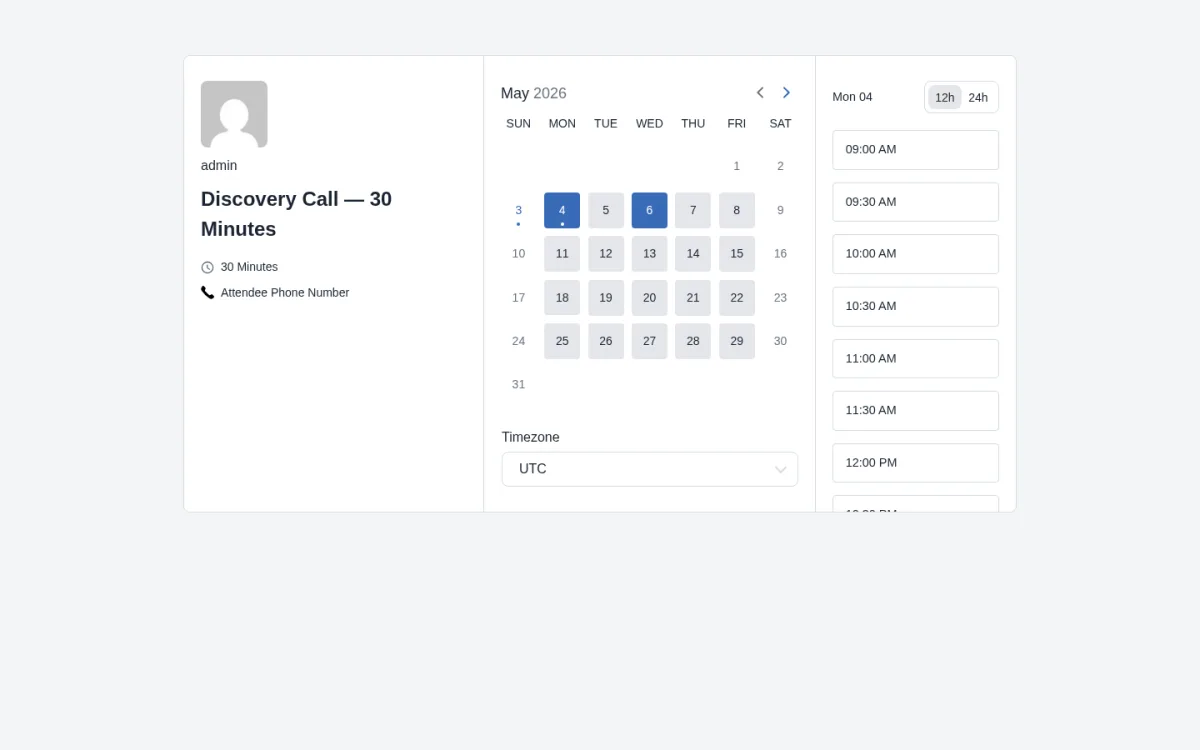
FluentBooking is the right answer when you realize you are looking at LatePoint for a job a Calendly-style scheduler would do better. In testing on a provisioned WordPress 6.9 environment with FluentBooking Pro 2.0.05, I built a Working Hours 9–5 availability schedule, a host calendar tied to the admin user, and a one-on-one Discovery Call event in about 15 minutes; the public landing page rendered the bookable event types under a single shareable URL, and the post-submit confirmation surfaced What / When / Who / Where with inline Cancel or Reschedule and Add-to-calendar shortcuts.
Why it is a strong alternative to LatePoint: Three reasons. First, FluentBooking sits in the Calendly-alternative slot rather than the multi-staff multi-location service-business slot — if your job is one-on-one bookings with a coach, consultant, sales rep, or freelancer, FluentBooking's Event Type editor and host Landing Page deliver a cleaner experience than configuring LatePoint's full Service → Date & Time → Customer Information → Verify Order Details → Submit model. Second, FluentBooking's Pro licensing follows the same logic LatePoint already gets right — every Pro plan unlocks every feature, plan tier only changes site count — so buyers leaving LatePoint do not have to re-learn a per-add-on or plan-tier-gated model on the way out. Third, the WPManageNinja ecosystem fit is genuinely deep: native FluentCRM and Fluent Forms hooks turn each booking into a CRM automation trigger, plus Zapier / Make / Pabbly Connect / FlowMattic / WP Fusion and raw webhook delivery. For buyers already running on the WPManageNinja stack, this is where FluentBooking turns scheduling into a multi-plugin operating system — and LatePoint does not have an equivalent in-house ecosystem.
What stood out in testing: The 11-tab Event Type editor (Event Details, Availability, Limits, Question Settings, Email Notification, SMS Notification, Recurring Settings, Advanced Settings, Payment Settings, Webhooks Feeds, Integrations) mirrors how Calendly organizes the same job, and going from a blank calendar to a working bookable event took under two minutes — a meaningful contrast to LatePoint's full agent / service / schedule setup when the actual job is one-on-one calls. The themeless, mobile-friendly two-pane public widget, the inline 12h / 24h toggle, and the calendar-shortcut confirmation page all sit well above the WordPress booking-plugin baseline.
Main strengths:
- Calendly-style admin and public booking flow inside WordPress with data ownership and one-time pricing.
- Same all-features-in-every-paid-plan licensing logic LatePoint uses — no surprise plan-tier learning curve.
- Deep WPManageNinja ecosystem fit (FluentCRM, Fluent Forms, FluentSMTP, FluentCart, Fluent Boards) — LatePoint has no equivalent in-house ecosystem.
- Genuine free version on WordPress.org so buyers can de-risk the choice (20,000+ active installs, 4.7/5).
Main limitations:
- Narrower payment route list (Stripe, PayPal, WooCommerce, FluentCart, Offline) — no native Mollie, Razorpay, Mercado Pago, Paystack, Square, or Klarna; LatePoint's Add-ons catalogue is broader on global gateways.
- Not built for multi-staff, multi-location service-business workflows — no booking packages, no customer portal, no waiting list. LatePoint's Locations + Agents model is ahead for service businesses.
- No native admin Cancel or Reschedule action on the booking detail screen; admin-side cancellations route through the customer link.
- No native mobile app, no white-label, no chart-based reporting, and a smaller community footprint than LatePoint (20,000+ active installs versus LatePoint's 100,000+).
Pricing snapshot: Free WordPress.org plugin; Pro Solo $79/yr or $249 lifetime for 1 site; Small Business $199/yr or $436 lifetime for 5 sites; Agency $399/yr or $749 lifetime for 50 sites. 14-day money-back guarantee. Public ratings: WordPress.org 4.7/5 from 41 reviews with 20,000+ active installs.
Read the full review: FluentBooking review
6. Simply Schedule Appointments
Best for: Solo consultants, coaches, lawyers, tutors, therapists, and small service teams running one WordPress site.
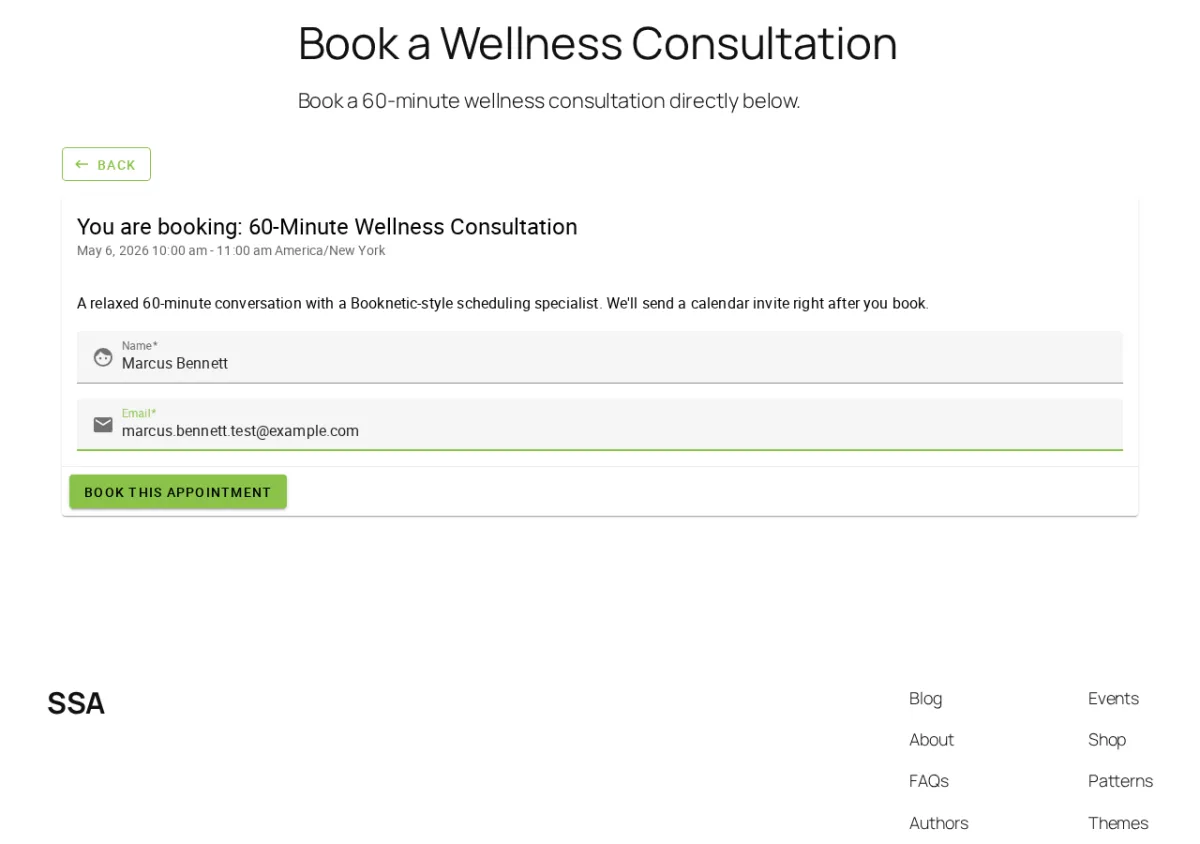
Simply Schedule Appointments — usually shortened to SSA — is the right pick when you realize LatePoint is overkill for a solo, single-location use case and an accessibility-aware widget is a real requirement. In testing on a private WordPress 6.9.4 site with the Pro Edition license, the Setup Wizard auto-detected the WP timezone, date format, and week-start, the Appointment Type editor built a working starter type in under five minutes, and the visitor-side widget auto-detected the visitor's timezone and walked through Date → Time → Customer Information → Confirmation.
Why it is a strong alternative to LatePoint: Three reasons. First, the WordPress.org rating profile is the strongest in this entire shortlist — 5/5 from 154 reviews on top of 60,000+ active installs — and recent reviewers report support responses within an hour, including on the free tier. LatePoint's WP.org rating (4.9/5 with 100,000+ active installs) is also excellent, but SSA's per-review average sits half a point higher with a Capterra-style support response pattern that matches it. Second, SSA's WCAG-AA accessibility focus (live contrast-ratio checker in the Styles module, screen-reader-friendly Morning / Afternoon / Evening slot grouping, accessible front-end widget) is genuinely rare in this category — and LatePoint does not advertise an equivalent accessibility surface. Third, the multi-block per-day availability with automatic lunch-gap exclusion is unusually clean — split a weekday into 09:00–12:00 plus 13:00–17:00 and the front-end widget excludes 12:00 and 12:30 from the slot grid automatically, which most competitors require a separate "break" record or manual workaround for.
What stood out in testing: The post-submit confirmation page surfaces Save-to-Calendar, Edit Information, Reschedule, Cancel Appointment, and Schedule a New Appointment side by side — a meaningful conversion-quality detail. LatePoint's Appointment Confirmed page surfaces Add to Calendar, Print, and Show QR, but SSA layers self-serve Reschedule and Cancel on top, which is an upgrade for solo consultants whose customers reschedule frequently. Three Booking Flow layouts (Expanded, Express, First Available) make a credible Calendly-on-WordPress experience for a single site.
Main strengths:
- Highest WordPress.org rating profile in this set — 5/5 from 154 reviews on top of 60,000+ active installs.
- Setup wizard reads WordPress timezone, date format, and week-start automatically — usable booking widget in under five minutes.
- Polished SPA admin with an accessibility-aware front-end widget and a live contrast-ratio checker — LatePoint gap.
- Confirmation page surfaces Save-to-Calendar, Reschedule, and Cancel side by side — richer than LatePoint's Print + Show QR set.
Main limitations:
- Every annual tier is single-site — multi-site coverage requires the separate lifetime SKUs at higher upfront prices ($449–$1,299). LatePoint Scale ($149/yr or $399 lifetime for 5 sites) is meaningfully cheaper for multi-site deployments.
- Team scheduling and Resource booking are gated to the most expensive Business tier; LatePoint includes Agents and Locations on every paid plan.
- No drag-and-drop admin calendar — only a list view with a date-range filter. LatePoint's Calendar (Month / Week / Day / List) is ahead.
- Only Stripe and PayPal as payment gateways; no Square, Mollie, Razorpay, Mercado Pago, or WooCommerce. No events module — same gap as LatePoint.
Pricing snapshot: Free Basic Edition on WordPress.org; Plus from $99/yr intro / $129 renewal or $299 lifetime; Pro from $199/yr intro / $249 renewal or $499 lifetime; Business from $399/yr intro / $499 renewal or $899 lifetime; multi-site lifetime SKUs ($449–$1,299) on a separate page. 30-day money-back guarantee. Public ratings: WordPress.org 5/5 from 154 reviews with 60,000+ active installs.
Read the full review: Simply Schedule Appointments review
Side-by-Side Decision Notes
This list spans full WordPress booking platforms, Calendly-style schedulers, and accessibility-first solo plugins, so the right pick depends mostly on which LatePoint pain point pushed you to look elsewhere.
- Choose Booknetic if you fit LatePoint's profile (multi-staff, multi-location, full WordPress booking platform) but the missing native mobile app, the missing white-label, the limited multilingual coverage, or the missing chart-based reporting are the dealbreakers — and you can live without a free WP.org tier on day one.
- Choose Amelia if you also run paid events alongside appointments and want a built-in Events module with QR-coded e-tickets — the rare differentiator LatePoint does not ship at any tier.
- Choose BookingPress if your priority is a broad payment gateway list (especially regional providers like Razorpay, Mercado Pago, Paystack, PayMongo, or Klarna) bundled into a single tier, plus a free Lite plan that allows unlimited websites.
- Choose Bookly Pro if track record and a perpetual lifetime license matter more than admin polish, and you are willing to assemble add-ons à la carte or buy a Business / Ultimate bundle.
- Choose FluentBooking if you are actually shopping for a Calendly alternative inside WordPress, not a multi-staff multi-location service-business platform — especially if you already run on FluentCRM and Fluent Forms.
- Choose Simply Schedule Appointments if you run a single WordPress site, value an accessibility-aware widget, want the highest WordPress.org rating in this set, and only need Stripe and PayPal as payment gateways.
- Stay on LatePoint if you have already decided Starter or Scale is the right tier, you value the modern isolated SaaS-style admin, the live-preview Booking Form customizer with drag-to-reorder steps, the visual Automation module, and the all-features-in-every-paid-plan licensing — and you accept the multilingual / mobile-app / white-label / events gaps in exchange for that feature mix and the strong WP.org and Trustpilot ratings.
If your business straddles two profiles — for example a multi-location service business that also runs paid events alongside appointments — Amelia bundles the events module with QR-coded e-tickets directly inside one plugin, while Booknetic complements that with a native mobile app and graphical reports for the multi-staff multi-location side of the business.
For a wider WordPress booking shortlist (including the source product itself and three more plugins outside this six-alternative list), see the cluster roundup of the best WordPress appointment booking plugins.
FAQ
What is the best LatePoint alternative?
Booknetic is the strongest direct alternative for most buyers leaving LatePoint, because it matches LatePoint's multi-staff multi-location profile and closes four of the five biggest LatePoint gaps in one plugin: native iOS/Android mobile app, white-label / backend rebrand, broader multilingual coverage, and a graphical revenue dashboard. The LatePoint review itself names Booknetic as the closest direct alternative when those gaps weigh on the decision. Amelia is the natural runner-up when the missing events-with-tickets module is the dominant criterion — it is the only plugin in this shortlist with a built-in events module with QR-coded e-tickets. BookingPress is the right pick when broad payment gateway coverage (especially regional providers) is the priority.
Is there a free LatePoint alternative on WordPress.org?
Yes — Amelia, Bookly Pro, FluentBooking, and Simply Schedule Appointments all ship a real free version on WordPress.org. BookingPress also offers a genuine free Lite plan with unlimited websites, but it is distributed through bookingpressplugin.com rather than the WordPress.org plugin directory. Bookly Pro has the longest WP.org track record (since October 2014, 562 free reviews); SSA has the highest WP.org rating profile (5/5 from 154 reviews on top of 60,000+ active installs); FluentBooking ships in the WPManageNinja stack with 20,000+ active installs. Booknetic does not currently advertise a free version on its main pricing page, so paid plans are the practical entry point there — the one place LatePoint's free WP.org listing remains genuinely better than the closest direct alternative.
Which LatePoint alternative is best for agencies?
For agencies that need to deploy a booking plugin across multiple client sites, Booknetic Premium ($199/yr or $599 lifetime for 5 domains) and Elite ($299/yr or $899 lifetime for unlimited domains), BookingPress Enterprise ($249/yr or $599 lifetime for 20 sites), and FluentBooking Agency ($399/yr or $749 lifetime for 50 sites) are the best multi-site-licensed picks. Booknetic Elite is the natural LatePoint Agency swap when feature parity plus white-label backend matters — LatePoint Agency ($299/yr or $599 lifetime for 100 sites) is the cheapest-per-site of any plan in this set, but it does not ship a white-label option, so agencies that need a branded admin should price Booknetic Elite against LatePoint Agency before committing.
Which LatePoint alternative is best for beginners?
Simply Schedule Appointments and Amelia are the easiest to live in for non-technical admins among the six alternatives, but the honest answer is that LatePoint itself is already one of the easiest WordPress booking plugin admins on the market — the published "10-minute setup" claim is realistic, the live-preview Booking Form customizer with drag-to-reorder steps is one of the most beginner-friendly customizers I tested anywhere, and the isolated SaaS-style admin keeps the workspace focused on booking work. Among the alternatives, SSA's setup wizard reads WordPress timezone, date format, and week-start automatically — usable booking widget in under five minutes. Amelia has a slightly heavier day-one experience because of the empty default state and the Employee → Location dependency, but its Customize hub matches LatePoint's customizer for ongoing branding.
Which LatePoint alternative is best for events with ticketing?
Amelia is the only plugin in this shortlist with a built-in events module that handles one-time and recurring events, multiple ticket tiers (VIP / General / Early Bird), waiting lists, and QR-coded e-tickets attached to confirmation emails. LatePoint does not ship any of those — weak event-booking support is the recurring negative on Reddit and community comparison sites. Bookly Pro can extend toward events through its Events add-on, which is the closest match within this shortlist after Amelia. None of LatePoint, Booknetic, BookingPress, FluentBooking, or SSA ships a comparable bundled events-with-tickets module out of the box, so if events are central to your site, Amelia is the natural pick.
Which LatePoint alternative has stronger multilingual coverage?
Booknetic has stronger out-of-the-box multilingual coverage and a built-in admin translator UI, which is the gap LatePoint's own roadmap acknowledges as a long-standing open feature request. Amelia ships with broader bundled locales than LatePoint and integrates with WPML / Polylang for full multilingual sites. Bookly Pro is also WPML-compatible. If multilingual coverage is the dominant criterion driving you off LatePoint, Booknetic is the most direct fix; Amelia is the most polished alternative with WPML integration; FluentBooking and SSA are not the right answer for multilingual-heavy sites.
Should I switch from LatePoint to one of these alternatives?
Not necessarily. LatePoint is one of the more polished WordPress booking admins on the market in 2026, with the second-highest WordPress.org install base in this set (100,000+ active installs), a 4.9/5 WP.org rating, a 4.8/5 Trustpilot rating, and an all-features-in-every-paid-plan licensing model that removes per-add-on math. Switch only if a specific LatePoint pain point — limited multilingual coverage, no white-label, no native mobile app, no chart-based reporting, no built-in events module with QR e-tickets, or the multisite licensing rule — is genuinely blocking your decision. If you have already mapped your business to Starter / Scale / Agency and you can live with the multilingual / mobile / white-label / events gaps in exchange for the modern admin and the bundled licensing, staying on LatePoint is rational.
Final Verdict
If you only take one recommendation from this guide: Booknetic is the cleanest LatePoint alternative for most readers running a multi-staff or multi-location WordPress service business, because it matches LatePoint's profile and closes four of the five biggest LatePoint gaps — native iOS/Android mobile app, white-label / backend rebrand, broader multilingual coverage, and a graphical revenue dashboard — while still delivering a polished isolated SaaS-style admin that matches LatePoint on day-to-day UX quality.
If Booknetic is not the right fit, the closest shortlist alternatives are Amelia (the only plugin here with a built-in Events module with QR-coded e-tickets, plus a real WP.org Lite and a polished Customize hub) and BookingPress (20+ payment gateways including regional providers, plus a Free Lite plan with unlimited websites). For the longest WP.org track record and a perpetual lifetime license with the largest paid-review footprint in the category, Bookly Pro is the standard. For a Calendly-style scheduler inside WordPress — when one-on-one bookings are the actual job — FluentBooking is the cleanest option in the six I tested. And for a solo professional who runs a single WordPress site, values an accessibility-aware widget, and wants the highest WordPress.org rating profile in the category, Simply Schedule Appointments is the natural pick.
LatePoint remains a credible default for solo professionals and small studios that want a modern, lightweight WordPress booking plugin with a real freemium entry point and one all-inclusive paid plan — the choice between LatePoint and these alternatives depends entirely on which buyer profile you fit and which specific gap is dominating the decision. The safest buying logic is to choose based on workflow fit, tested usability, the price-to-value at the tier you actually need, and the support and reputation evidence you can verify before purchase — and then validate your shortlist against your specific service, staff, and payment requirements before you commit.
Similar Blogs


