

Booknetic vs LatePoint: Pricing, Features & Which One to Choose for WordPress Bookings

If you are choosing between Booknetic and LatePoint, you are choosing between two of the more modern WordPress appointment booking plugins on the market — and the wrong pick can quietly cost you a year of staff training, plan upgrades, and integration rework. Both run a real service business on WordPress, both ship an isolated SaaS-style admin, and both have public ratings strong enough to take seriously. The honest decision comes down to which buyer profile each plugin actually fits.
I tested both plugins end-to-end inside the WordPress admin. For Booknetic, that meant configuring a wellness studio in WordPress 6.9.4 with Booknetic 5.2.6 and the full Boostore add-on suite, then submitting a complete front-end booking and verifying it landed in Calendar, Appointments, and Customers. For LatePoint, that meant doing the same in a hosted WordPress sandbox with the Pro Features add-on plus the broader paid Pro add-ons (Google Calendar + Meet, Zoom, Mailchimp, the available payment gateways, Twilio SMS, WhatsApp, Short.io) — building one agent, one $95 service, one shortcoded page, and walking the public widget through Service Selection → Date & Time → Customer Information → Verify Order Details → Submit twice in a single session. I cross-checked both pricing pages, read public reviews on WordPress.org, CodeCanyon, Capterra, Trustpilot, and Reddit, and aligned the verdict with the cluster's testing notes and review drafts.
This is a practical comparison, not a brand pitch. Below is the side-by-side evidence, an honest verdict per use case, and a clear recommendation for the buyer profiles each plugin actually fits.
Quick Verdict: Booknetic vs LatePoint
Both plugins are good answers to the WordPress appointment booking question. The pick depends on what your business actually does.
- Choose Booknetic if you run a WordPress-based multi-staff service business and want a complete platform — real workflow automation, broad multilingual coverage, white labeling on Elite, a native mobile app for staff, and a 50+ paid add-on Boostore inside the admin.
- Choose LatePoint if you want a real free starting tier on WordPress.org, a single all-inclusive paid plan with no per-add-on math, and a modern lightweight admin that feels like a SaaS booking app on day one.
Quick mapping by buyer profile:
- Overall winner for a multi-staff WordPress service business: Booknetic — broader operational depth and a native mobile app for staff.
- Best free starting tier: LatePoint — real free version on WordPress.org; Booknetic does not advertise a free tier.
- Best for solo professionals and small studios: LatePoint — every paid plan unlocks every feature and every add-on.
- Best for agencies needing white label or a native mobile app: Booknetic — Elite includes white labeling and the mobile app is a Boostore add-on.
- Best for agencies needing the highest single-license site cap: LatePoint Agency — one license activates on up to 100 sites.
- Best for buyers who hate per-add-on shopping: LatePoint — flat all-inclusive paid plans, period.
Quick Comparison Table
| Criteria | Booknetic | LatePoint |
|---|---|---|
| Best for | WordPress service businesses, multi-location brands, agencies | Solo professionals, small studios, lifetime-license buyers, freemium-first owners |
| Starting price | $45/ | Free on WordPress.org; Starter from $79/ |
| Free version / trial | No live free version; 14-day money-back on paid plans | Genuine free tier on WordPress.org; 14-day money-back on paid plans; 11-month installment option on lifetime |
| Core workflow fit | Step-by-step widget + dedicated SaaS-style admin + drag-and-drop Calendar + Workflow engine + Boostore | Overlay-modal step widget + isolated SaaS-style admin + live-preview Booking Form customizer + visual Automation Workflows |
| Feature depth | Broad core; 50+ paid Boostore add-ons; native mobile app; white label on Elite | Broad core with the Pro Features bundle; no white label; no native mobile app; no chart-based reporting |
| UI/ | Full-screen panel hides standard WordPress chrome (8.7/ | Isolated SaaS-style chrome on every LatePoint screen with live-preview Booking Form customizer (8.4/ |
| Pricing/ | Premium and Elite are where the value lands once Boostore add-ons enter the picture | Flat all-features-in-every-paid-plan licensing; Starter lifetime pays back in roughly 30 months on a single site |
| Integrations / payments | Stripe, PayPal, Square, Mollie, Razorpay, Mercado Pago, Vipps, 2Checkout, Netopia, plus Telegram and Amazon SNS via Boostore | Stripe (free tier), then PayPal, Square, Mollie, Braintree, Flutterwave, Mercado Pago, Paystack, Razorpay, SureCart, WooCommerce on any paid plan; Apple Calendar, Outlook + Teams, Zoom |
| Support / reputation | CodeCanyon 4.91/ | WordPress.org 4.9/ |
| Best reason to choose it | Most complete WordPress booking platform with native mobile app and in-panel add-on marketplace | Real free tier and one all-inclusive paid plan — no per-add-on shopping list |
| Main reason to skip it | No free tier and many high-value capabilities live in paid Boostore add-ons | No white label, no native mobile app, no chart-based reporting, weak event-booking, limited multilingual |
| Full review | Booknetic review | LatePoint review |
Product Overview
What is Booknetic?
Booknetic is a WordPress appointment booking and scheduling plugin built by FS Code that runs entirely inside a self-hosted WordPress site. It targets service businesses — wellness studios, clinics, salons, fitness centers, tutors, consultants, and agencies — that prefer WordPress-native control over a separate SaaS scheduler. The product covers the standard booking jobs (services, staff, locations, schedules, customers, payments, notifications) inside a dedicated full-screen admin panel and renders a step-by-step booking widget on the public site through a single shortcode. Most commercially important capabilities — Stripe, Google Calendar, Zoom, SMS, white labeling, native mobile app — are sold as paid Boostore add-ons rather than bundled into the base plan. Plans are differentiated mostly by how many of those add-ons are included, with all 50+ unlocked on Elite.
What is LatePoint?
LatePoint is a self-hosted WordPress appointment booking plugin built for service-based small businesses — salons, beauty studios, fitness coaches, photographers, tutors, consultants, and clinics. It runs as a freemium plugin on WordPress.org plus three paid plans on latepoint.com. Its commercial pitch is "set up in 10 minutes, no nickel-and-diming": every paid plan unlocks every feature and every add-on, and the only difference between paid tiers is how many WordPress sites the license activates on. The plugin lives inside WordPress, but every LatePoint admin screen renders an isolated SaaS-style panel — when you load any LatePoint page, the standard WordPress sidebar and top bar are hidden and you work inside LatePoint's own chrome. The free tier is a genuine product, with multiple agents, multiple services, basic email notifications, and Stripe-only payments included.
Setup and Onboarding
LatePoint is faster on day one. The published "10 minute" claim is realistic for the basic widget — configuring one agent, creating one service with a duration and price, and publishing one WordPress page with the LatePoint book-button shortcode is enough to put the booking widget live, and most paid Pro add-ons activate with a one-click toggle in the Add-ons catalogue. The Booking Form customizer's live preview removes the usual CSS detour for owners who just want to brand the widget.
Booknetic onboarding is more deliberate. The Starting Guide walks new admins through Company details → Business hours → Create location → Create staff → Create service in a logical order, and the dedicated full-screen admin panel removes most of the WordPress chrome while you work. The trade-off is depth: General Settings and the Service modal each carry a fair amount of optionality, so plan an extra hour after the basics for payment, calendar sync, and notification add-ons that need third-party credentials.
Winner: LatePoint — faster first-time setup and a more guided onboarding experience for buyers who want a working booking form in an evening.
Admin UI and Ease of Use
Both admins use the same broad pattern — hide WordPress chrome, render a SaaS-style panel — and both execute it well, but the day-to-day feel diverges.
Booknetic loads its own full-screen panel inside WordPress with its own sidebar — Dashboard, Calendar, Reports, Appointments, Packages, Customers, Services, Staff, Locations, Workflow, Boostore, Appearance, Coupons, and Settings — and hides the WordPress top bar while you are inside it. Most modules use a consistent datatable + modal pattern, so the learning curve flattens after the first few screens. The admin Calendar offers Month / Week / Day / List views with drag-and-drop rescheduling and an Advanced filter for staff, service, and status — what service-business admins actually spend most of their time on. Reports include a chart-based revenue graph, which LatePoint does not match.
LatePoint goes further on isolation: when you load any LatePoint screen, the standard WordPress sidebar and top bar are gone entirely, and you work inside LatePoint's own left rail (Dashboard, Calendar, Appointments, Orders, Payments, Customers, Services, Agents, Locations, Coupons, Settings, Automation, Integrations, Form Fields, Add-ons) and a top bar with global search, chat / clock / inbox icons, a "+ Booking" quick-create, and an admin avatar. The live-preview Booking Form customizer is one of the most beginner-friendly admin panels in the category — colour swatch picker, Border Style dropdown, drag-to-reorder Steps panel, Left / Top tabs toggle. The trade-off is reporting: there is no chart-based reports module today, only datatables.
Winner: Tie — Booknetic wins on day-to-day calendar workflow and reporting depth; LatePoint wins on admin isolation and the live-preview branding tools that non-technical owners reach for first.
Frontend User Experience
Both front-end widgets are clean, short, and convert cleanly to a confirmation. The differences are step count and how much each widget anticipates the customer.
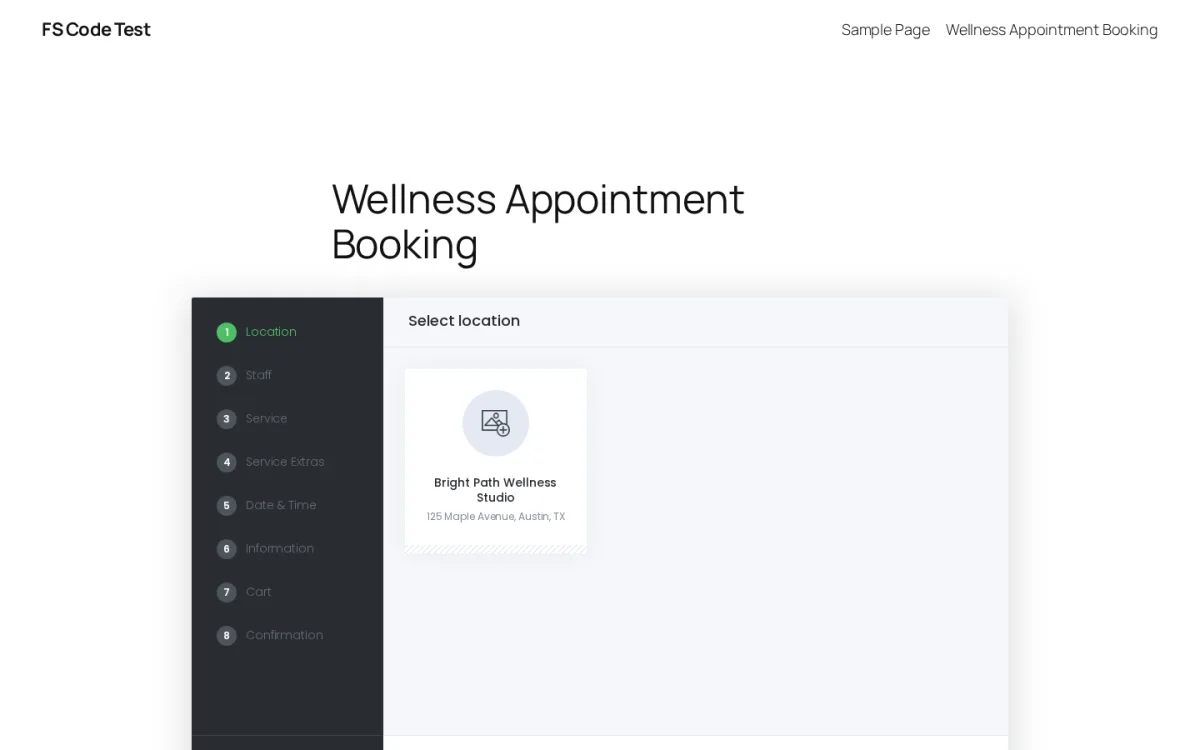
Booknetic renders a longer step strip — Location → Staff → Service → Service Extras → Date & Time → Information → Cart → Confirmation — with a clear sidebar showing progress. The Service Extras step auto-skips when no extras are configured. In testing, picking a location auto-loaded the linked staff, the staff card filtered to the linked services, and the Date & Time step rendered the calendar grid with available days marked in green. The confirmation screen exposes a confirmation number plus Add to Google Calendar and Add to iCal buttons inline.
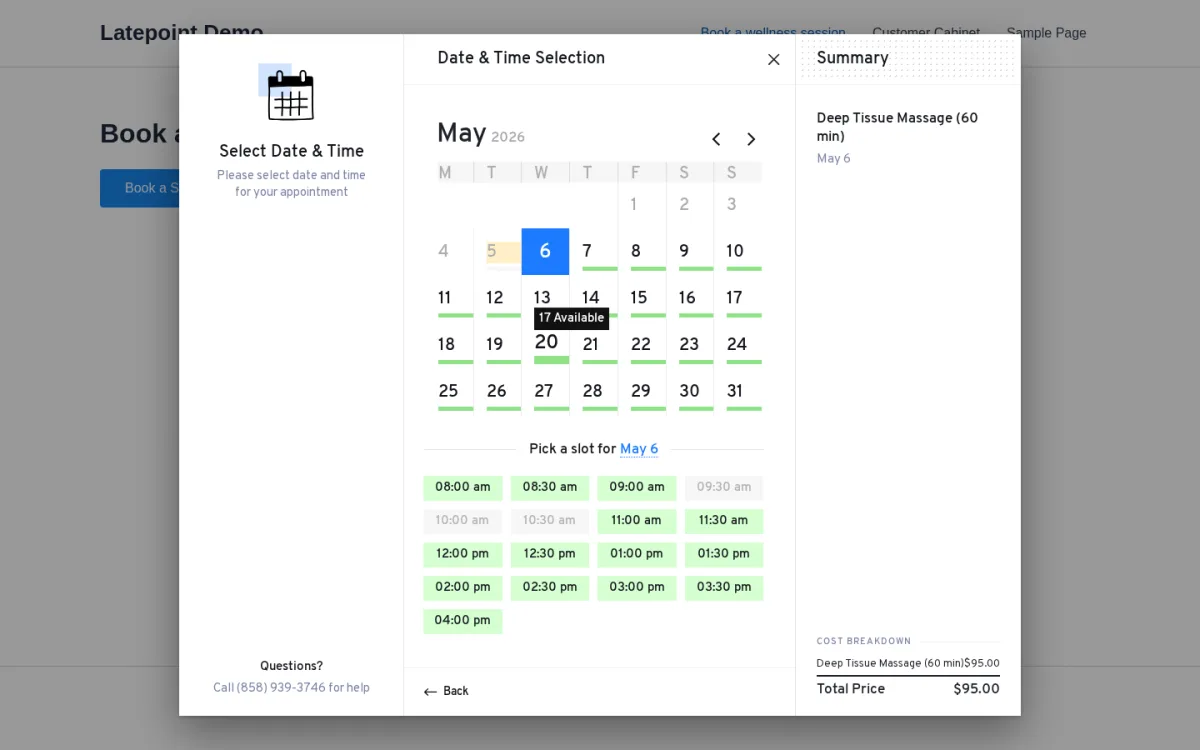
LatePoint renders the widget as an overlay modal with a clean step strip — Service Selection → Date & Time → Customer Information → Verify Order Details → Submit — a friendly left-side step icon and helper text, and a right-side Summary panel that updates live as the customer progresses. The Date & Time picker shows a full-month calendar with green availability bars under each bookable date and slides in a vertical time list at the configured slot interval the moment a date is picked. After Verify Order Details is submitted, the Appointment Confirmed page exposes the Order code plus Add to Calendar, Print, and Show QR buttons.
Winner: Tie — Booknetic's longer flow is built for businesses with multiple locations and staff to choose from; LatePoint's tighter overlay and live Summary panel feel a step ahead for solo or small-studio bookings. Both are above the WordPress booking-plugin baseline.
Features and Workflow Depth
Both plugins cover the foundational booking jobs — services, staff/agents, locations, schedules, customers, deposits, recurring appointments (LatePoint Pro-only), group/multi bookings, coupons, taxes, custom forms, REST API. The differentiation lives at the edges.
Booknetic is broader on operational depth and customization. The Workflow engine maps booking events (created, approved, rescheduled, completed, cancelled) to actions like email, SMS, WhatsApp, Telegram, webhook, or Mailchimp through a builder that has been in production for years. The Boostore catalog includes packages, gift cards, loyalty points, staff commissions, custom statuses, custom forms with conditional logic, white-label, and a native mobile app — most of which LatePoint does not offer at all. Multilingual coverage is broader and chart-based revenue reporting is built in. If the business needs a real-events module or true ticketing, neither plugin is the right pick — Amelia would be a stronger fit (covered in the alternatives section).
LatePoint is intentionally narrower and lighter. The Pro Features bundle plus the rest of the paid Pro add-ons cover the booking jobs most service-based small businesses actually need — Stripe and broader payment gateways, Google Calendar two-way sync, Zoom and Google Meet, Mailchimp, Twilio SMS, WhatsApp, Short.io. The Automation module ships with a visual workflow builder (Trigger → Conditions → Actions → Time Offset) and a default New Booking Notification workflow that fires on every new booking. The Form Fields editor with Required + Width toggles, the live-preview Booking Form customizer, and the OTP gate on first contact are real day-to-day quality-of-life wins. What LatePoint deliberately does not ship: white-label, native mobile app, chart-based reporting, a deep events / ticketing layer, broad multilingual.
Winner: Booknetic — broader operational depth, more add-on coverage, white-label, and a mobile app for staff. LatePoint earns the win only when the buyer specifically wants the lighter scope.
Pricing and Add-on Model
The pricing models are structurally different, which matters more than the headline numbers.
Booknetic's plan logic is mostly about how many Boostore add-ons are included, not core feature caps:
- Basic — $45/yr or $99 lifetime — 1 domain — 6 months support — 0 paid add-ons
- Standard — $99/yr or $239 lifetime — 1 domain plus staging — 6 months support — 8 paid add-ons of your choice
- Premium — $199/yr or $599 lifetime — 5 domains plus 5 staging — 1 year support — 19 paid add-ons of your choice
- Elite — $299/yr or $899 lifetime — unlimited domains — 1 year priority support — all 50+ paid add-ons included
Booknetic ships a 14-day money-back guarantee on paid plans and does not currently advertise a free version on the pricing page.
LatePoint's plan logic is the opposite — every paid tier unlocks every feature and every add-on, and the tiers differ only by site cap:
- Free — $0 — 1 site — basic booking form, multiple agents and services, basic email notifications, Stripe-only payments, admin calendar
- Starter — $79/yr (sale, regular $99) or $199 lifetime (sale, regular $249) — 1 site — all paid features and all add-ons
- Scale — $149/yr (sale, regular $249) or $399 lifetime (sale, regular $599) — 5 sites — all paid features and all add-ons
- Agency — $299/yr (sale, regular $499) or $599 lifetime (sale, regular $1,299) — 100 sites — all paid features and all add-ons
LatePoint ships a 14-day money-back guarantee on paid plans, and lifetime plans offer an 11-month installment option.
The honest take: LatePoint is the cleaner SKU at every paid tier — flat pricing, every add-on included, real free tier. Booknetic is the better deal at the top end when you actually need the long tail of capabilities (mobile app, white label, gift cards, loyalty, packages, regional payment gateways) — at that point, Elite's $899 lifetime starts to look like a bargain because you would need a SaaS scheduler subscription for half of those features otherwise.
Winner: LatePoint for headline simplicity and free entry; Booknetic Elite for "the long tail of capabilities I actually need." Map your add-on list to the tier before choosing.
Integrations and Payments
Both plugins ship the integrations most production sites need, but at different tiers and with different gaps.
Both support Stripe at the entry tier (Booknetic via a Boostore add-on slot from Standard up; LatePoint Free includes Stripe-only). Both support Google Calendar two-way sync, Zoom, Google Meet, and WhatsApp at the right tier. Both expose a REST API and webhooks.
Booknetic's payment gateway breadth via Boostore is the wider catalog when regional providers matter: Stripe, PayPal, Square, Mollie, Razorpay, Mercado Pago, Vipps, 2Checkout, Netopia, plus regional providers. Booknetic also covers notification routing more broadly — Telegram and Amazon SNS via Boostore in addition to email and SMS, alongside the Workflow engine that LatePoint matches at a smaller scale.
LatePoint's edge on the integration side is the all-included nature of the paid plans. PayPal, Square, Mollie, Braintree, Flutterwave, Mercado Pago, Paystack, Razorpay, SureCart, and WooCommerce gateways are bundled with every paid tier as one-click activations in the Add-ons page. Apple Calendar, Outlook + Teams, Zoom, Mailchimp, Twilio SMS, WhatsApp, and Short.io are also one-click activations on any paid plan. There is no Telegram channel and no Amazon SNS. There is also no native mobile app — Booknetic is the only one of the two with that capability.
Winner: Booknetic for payment gateway breadth (especially for regional markets) and channel diversity (Telegram, Amazon SNS, mobile app); LatePoint for Apple Calendar, Outlook + Teams, and the simplicity of "every gateway included on every paid plan."
Support, Documentation, and Reputation
Both vendors run serious documentation libraries and active communities, but the public review picture sits in different places.
Booknetic — CodeCanyon 4.91/5 (471 reviews) is a strong verified-buyer rating; CodeCanyon requires a verified purchase before leaving feedback. Capterra sits at 4.5/5 (103 reviews) with ease of use 4.4 and customer service 4.3. Trustpilot is the outlier at 3.4/5 (21 reviews — small sample). Recurring complaints in public threads cluster around add-on cost and the gap between Basic and the plans that actually include the add-ons buyers need. Live chat is available alongside ticket and email support, plus a Discord community of ~2,633 members.
LatePoint — WordPress.org 4.9/5 with 100,000+ active installations and Trustpilot 4.8/5 are the two best public ratings in this comparison. Reviewers consistently mention easy setup, responsive support, and several years of stable production use. Negative threads tend to focus on the misleading free-tier marketing (Google Calendar advertised but Pro-only) and a documentation gap reported by a smaller share of 4-star Trustpilot reviewers, rather than ticket latency. Support runs through email and a ticket system on latepoint.com plus the WordPress.org community support forum for free-tier users — there is no live chat. Documentation lives at wpdocs.latepoint.com, screenshot-heavy on popular pages and lighter on advanced configurations.
Winner: LatePoint — the WordPress.org and Trustpilot ratings on a much larger sample base put it at the top of this comparison's reputation table. Booknetic's CodeCanyon score is excellent but on a smaller verified-buyer pool, and the live-chat option is the one channel LatePoint does not match.
Performance and Reliability Impression
Performance was a tie in testing.
Booknetic admin pages loaded within ~1–2 seconds across modules in the test environment, the front-end booking widget transitioned between steps without visible lag, and the Date & Time step rendered the calendar grid plus available-day markers in well under a second after each click. Booknetic has shipped point releases (5.2.0, 5.2.4, 5.2.6, plus a 5.6.0 beta) on a steady cadence with no public outage events flagged in the recent six months.
LatePoint admin pages opened in roughly one to two seconds and the public widget moved between steps without lag in the same test window. Two consecutive customer bookings landed cleanly in the Appointments list, on the Calendar, and as auto-created customer records in a single session, with no retries needed. The 100,000+ active installations on WordPress.org and the 4.9/5 rating speak to a long production history; reviewers regularly mention several years of stable use.
Winner: Tie — both plugins were responsive in testing and both have clean recent reliability records.
Pricing Comparison
Quick side-by-side at the official tiers (verify current sale or regular pricing on each vendor's pricing page before buying):
- Free tier: LatePoint ships a real free plugin on WordPress.org with multiple agents, multiple services, basic email notifications, and Stripe-only payments; Booknetic does not currently advertise a free version on its pricing page.
- Entry paid tier: Booknetic Basic at $45/yr or $99 lifetime is the cheapest absolute entry price, but it ships zero paid add-ons. LatePoint Starter at $79/yr (sale) or $199 lifetime (sale) costs more on paper but includes every paid feature and every add-on.
- Mid tier: LatePoint Scale at $149/yr (sale, $249 regular) or $399 lifetime (sale, $599 regular) covers 5 sites with everything included. Booknetic Premium at $199/yr or $599 lifetime covers 5 domains plus 5 staging with 19 paid add-ons of your choice.
- Top tier: LatePoint Agency at $299/yr (sale, $499 regular) or $599 lifetime (sale, $1,299 regular) covers 100 sites with everything included. Booknetic Elite at $299/yr or $899 lifetime covers unlimited domains with all 50+ paid Boostore add-ons (mobile app, white label, every payment gateway, every notification channel, every commerce module).
- Refund policy: Booknetic 14-day money-back; LatePoint 14-day money-back, plus an 11-month installment option on lifetime plans.
The honest pricing conclusion: LatePoint is the simpler value proposition — every paid plan unlocks everything and the lifetime entry is $199 sale (single site). Booknetic is the deeper proposition — lower entry price for buyers who only need the core, and Elite is the only tier in this comparison that covers white labeling, a native mobile app, packages, gift cards, loyalty points, staff commissions, and the broadest payment gateway catalog inside one license.
Who Should Choose Booknetic?
- WordPress service businesses (wellness, clinics, salons, fitness, consulting, tutoring) that want a polished booking flow on their own site and a complete platform behind it
- Multi-staff and multi-location brands that need real schedule, location, and staff modeling, not just a single calendar
- Agencies running multiple client booking sites that want a Boostore-style add-on catalog inside the admin and white labeling on Elite
- Operators who want a native mobile app for staff so the team can manage schedules, check-ins, and bookings on iOS and Android
- Businesses that need broad payment gateway coverage across regional markets (Mercado Pago, Vipps, Razorpay, Mollie, 2Checkout, Netopia, plus the global standards) or Telegram / Amazon SNS notification routing
- Owners who need chart-based revenue reporting, deeper multilingual coverage, or commerce modules like packages, gift cards, loyalty points, and staff commissions
- Buyers willing to pay an annual or one-time lifetime license to avoid a SaaS scheduler subscription, and comfortable choosing the Boostore add-on mix for their tier
If Booknetic is close but not quite the right fit, the round-up of Booknetic alternatives groups the closest WordPress booking plugins by workflow fit and pricing model.
Who Should Choose LatePoint?
- Solo professionals and small studios that want a polished booking widget without a per-add-on shopping list
- Buyers who want a real free starting tier on WordPress.org with multiple agents and services, and a clear paid path when the free limits bite
- Lifetime-license buyers who prefer a one-time fee on Starter to a recurring SaaS bill, especially with the 11-month installment option on lifetime plans
- Owners who care about admin polish — the isolated SaaS-style chrome and the live-preview Booking Form customizer are real, day-to-day quality-of-life wins
- Buyers who hate per-add-on math and want every paid plan to unlock every feature and every add-on
- Agencies that want one license to cover a high site count without per-add-on slot calculations — Agency activates on up to 100 sites
- Businesses that do not need broad multi-language coverage, white-labeling, native mobile, or chart-driven reporting
If LatePoint is close but not quite the right fit, the round-up of LatePoint alternatives groups the closest WordPress booking plugins by workflow fit and pricing model.
Alternatives to Both
If neither plugin is a perfect fit, two alternatives are worth a serious look before you decide.
Amelia
A heavyweight WordPress booking plugin known for a polished Vue + Element Plus admin SPA and a rare built-in events module with QR-coded e-tickets, multiple ticket tiers, and waiting lists. A better pick than either Booknetic or LatePoint when ticketed events sit alongside appointments at the center of the business. See the full Amelia review for the detailed feature breakdown.
BookingPress
An all-inclusive WordPress booking plugin with a real free Lite tier and bundled add-on plans covering 60+ modules and 20+ payment gateways inside every paid plan. A better fit than either Booknetic or LatePoint when bundled add-on coverage matters more than the SaaS-style admin or you want even broader feature breadth than LatePoint at a comparable price. See the full BookingPress review for pricing detail.
For the broader picture of seven plugins tested side-by-side in this category, the cluster's best WordPress appointment booking plugins roundup is the next stop.
FAQ
Is Booknetic better than LatePoint?
It depends on the use case. Booknetic is the more complete WordPress booking platform for multi-staff service businesses, multi-location brands, and agencies — it ships a dedicated SaaS-style admin, a native mobile app, broad multilingual coverage, white labeling on Elite, and an in-panel Boostore marketplace covering 50+ paid add-ons. LatePoint is the better choice if you want a real free starting tier, a single all-inclusive paid plan with no per-add-on math, or the lightweight admin polish that solo professionals and small studios reach for first. Both are credible picks; the right answer is the one whose strongest feature set matches your business model.
Which is cheaper: Booknetic or LatePoint?
LatePoint has the cheapest real entry point — it is free on WordPress.org with multiple agents and services. Booknetic has the cheapest paid entry tier in absolute dollars (Basic at $45/yr or $99 lifetime), but Booknetic Basic ships zero paid add-ons, so most buyers end up on Standard, Premium, or Elite. At the top tier, LatePoint Agency lifetime is $599 sale ($1,299 regular) for 100 sites with everything included; Booknetic Elite lifetime is $899 for unlimited domains with all 50+ paid add-ons including white label and the native mobile app. The cheaper pick depends on which side of the bundle math your add-on list lands on.
Which is easier for beginners?
LatePoint. The published "10 minute" setup claim is realistic for the basic widget, the isolated SaaS-style chrome removes WordPress distraction on every screen, and the live-preview Booking Form customizer lets non-technical owners brand the widget without touching CSS. Booknetic has a polished onboarding too, but General Settings and the Service modal each carry more depth than LatePoint's equivalents, so the day-one learning curve is steeper.
Which is better for agencies or multiple sites?
It depends on the agency's needs. Booknetic Premium ($199/yr or $599 lifetime) covers 5 domains plus 5 staging licenses with 19 paid Boostore add-ons of your choice, and Booknetic Elite ($299/yr or $899 lifetime) covers unlimited domains with all 50+ add-ons including white labeling — the natural agency tier when client rebrand or a native mobile app is on the table. LatePoint Agency ($299/yr or $599 lifetime sale) activates on up to 100 sites with every feature and every add-on included — the cleaner SKU when the agency wants flat pricing and does not need white label or a mobile app.
Does Booknetic have a free version like LatePoint?
No. Booknetic does not currently advertise a free version on its official pricing page; paid plans are the practical entry point, with a 14-day money-back guarantee. LatePoint ships a real free plugin on WordPress.org that supports multiple agents, multiple services, basic email notifications, and Stripe-only payments — most other capabilities (Google Calendar two-way sync, customer dashboard, recurring appointments, OTP, non-Stripe gateways) sit behind the paid plans.
Does LatePoint have a mobile app like Booknetic?
No. LatePoint does not ship a native iOS or Android app — all admin and staff work runs through the browser. Booknetic ships a native mobile app for staff and admins as part of its plans. For service businesses where staff need to manage schedules and check-ins on a phone, Booknetic is the more natural pick today.
Final Verdict
Booknetic and LatePoint are both serious WordPress appointment booking plugins, and the right pick depends on what your business actually does. For a typical multi-staff WordPress service business — wellness, clinics, salons, fitness, consulting, tutoring — Booknetic is the more complete platform: a dedicated SaaS-style admin, a real Workflow engine, an in-panel Boostore marketplace covering 50+ paid add-ons, broader payment gateway coverage, broader multilingual, chart-based reporting, white labeling on Elite, and a native mobile app for staff. For solo professionals, small studios, and freemium-first owners, LatePoint is the better fit — the real free tier on WordPress.org, the one all-inclusive paid plan with no per-add-on math, the live-preview Booking Form customizer, and the isolated SaaS-style chrome on every admin screen are real, day-to-day advantages. The biggest trade-off either way is honest: Booknetic loses some appeal at Basic and Standard because most high-value capabilities live in paid Boostore add-ons; LatePoint loses appeal once white label, a native mobile app, chart-based reporting, or broad multilingual coverage become non-negotiable. If your business straddles both profiles — multi-staff appointments today, agency rebrand or mobile-app staff workflow tomorrow — Booknetic is the safer long-term answer, but the cluster's best WordPress appointment booking plugins roundup is worth reading before you commit either way.
Similar Blogs


