

8 Best Free WordPress Speed Optimization Plugins for 2026


Why a fast WordPress site still matters in 2026
If your WordPress site takes longer than two or three seconds to load, you are bleeding visitors before the page even paints. Google's Core Web Vitals (LCP, INP, CLS) remain ranking signals in 2026, and the AI search experiences layered on top of search (Google AI Overviews, Bing Copilot, Perplexity) all favor pages that render quickly so their crawlers and live previews can grab content without timing out.
The good news: most of the gains on a typical WordPress site come from four boring fixes. Caching the HTML so PHP does not run for every visitor. Optimizing CSS, JavaScript and HTML so browsers parse less. Compressing images and serving WebP or AVIF. Keeping the database lean. You do not need a paid plugin to do any of those things in 2026.
This is a 2026 refresh of our older speed-plugin roundup. I verified each plugin's version, install count, rating, review count and pricing against the live WordPress.org listing and vendor pricing pages on 2026-05-24. I dropped two plugins that no longer earn their place (Swift Performance Lite is effectively abandoned at around 7,000 installs and a 3.6 out of 5 rating, SG Optimizer only matters if you host with SiteGround), removed WP Rocket because it has never had a free tier, and added GT Performance (free for personal use, $199 one-time for commercial) plus four widely available free plugins that any WordPress user can install today.
If you want a broader, non-plugin overview of speed work, read our WordPress Speed Optimization guide first. This article is the tactical companion that names the actual free plugins.
How I evaluated each plugin
For each of the eight plugins I verified the following against the live WordPress.org plugin page and the vendor's site on 2026-05-24:
- Active installs, rating, review count (community trust signals).
- Latest version, last release date, tested up to WordPress version, required PHP version (so you know it is actively maintained).
- What the free tier actually does, separated from what the Pro upsell unlocks.
- Server requirements, where relevant. LiteSpeed Cache, for example, only gives you genuinely server-level cache on LiteSpeed / OpenLiteSpeed / QUIC.cloud; the rest of its features work anywhere.
- Conflicts and known footguns based on current vendor docs and recent 2026 reviews on the WordPress.org reviews tab.
I prioritized plugins with a usable free version, not plugins that gate every meaningful feature behind a paid upgrade. If a plugin's "free" tier was a 14-day trial in disguise, it did not make the list.
For the admin-screen observations below, I used each vendor's current WordPress.org screenshots, official setup instructions, 2026 changelog, documentation and recent public reviews. I did not include any claim based on an unverified sandbox interaction.
Quick comparison table
| Plugin | Best for | Active installs | Rating | Free tier covers | Server needs |
|---|---|---|---|---|---|
| GT Performance | Cloudflare-aware page cache, server-side unused CSS, Redis, and commerce safeguards | Direct (not on WordPress.org) | N/A (direct sales) | Full feature set on one personal site (free); $199 one-time for commercial use | WordPress 6.6+, PHP 8.1+; Cloudflare account for edge sync features |
| LiteSpeed Cache | All-in-one performance on LiteSpeed / OpenLiteSpeed hosts | 7+ million | 4.8 / 5 | Cache, image opt, minify, CDN (QUIC.cloud), critical CSS | Server cache features need LiteSpeed; general features run anywhere |
| WP-Optimize | One plugin for cache, image compression, minify and database cleanup | 1+ million | 4.8 / 5 | All four functions in free | Any host |
| W3 Total Cache | Granular caching for technical users on any host | 900,000+ | 4.4 / 5 | Page, object, browser, database, fragment caching, minify, CDN | Any host (Memcached / Redis optional) |
| WP Super Cache | Simplest reliable cache for blogs on shared hosting | 1+ million | 4.3 / 5 | Three caching modes including mod_rewrite static files | Any host with mod_rewrite (Apache) for fastest mode |
| Autoptimize | CSS, JS, HTML minify and image lazy-loading next to your cache plugin | 900,000+ | 4.7 / 5 | Aggregation, minification, defer JS, inline CSS, WebP / AVIF, lazy load | Any host |
| Smush | Free image optimization and lazy load with no monthly limit | 1+ million | 4.8 / 5 | Lossy / lossless compression for images up to 5 MB, lazy load, bulk smush | Any host (WPMU DEV account optional) |
| ShortPixel Image Optimizer | Free monthly credit with the widest format support | 300,000+ | 4.5 / 5 | 100 image credits per month, WebP and AVIF, PDF compression, lazy load | Any host |
1. GT Performance: page cache, Cloudflare Free and Redis in one plugin
- Official page: gauravtiwari.org/gt-performance
- Free tier: One personal website, all 76 modules included, lifetime license
- Paid: $199 one-time for 25 websites, lifetime license
- Version: 1.0.0
- Requires: WordPress 6.6+, PHP 8.1+
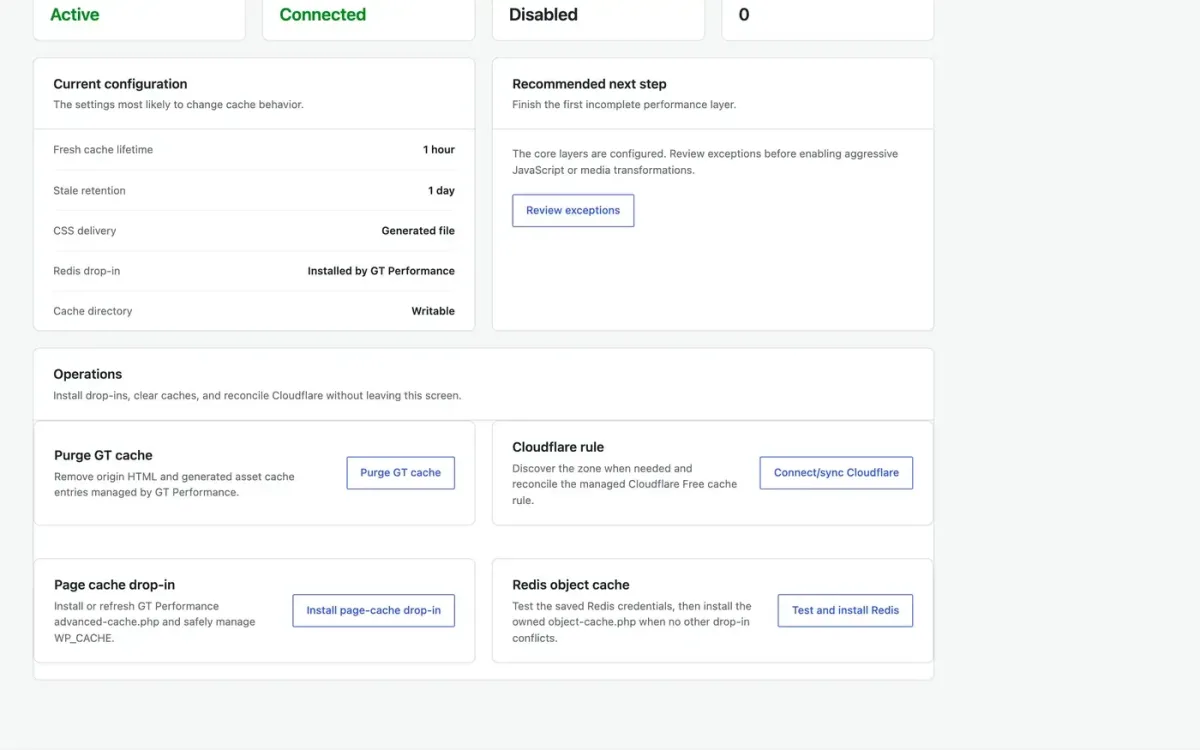
What it is. GT Performance is a WordPress cache and Cloudflare integration plugin from Gaurav Tiwari. It combines page caching, Cloudflare Free plan management, server-side unused CSS removal, Redis object caching, and commerce safeguards for FluentCart, WooCommerce, and Easy Digital Downloads into one admin. The plugin ships 76 modules across 12 groups. Every module is available in both the free and paid tier; opt-in controls keep the aggressive settings disabled by default until you enable them deliberately.
Why it leads the list. Most speed plugins treat page caching and Cloudflare as separate concerns. GT Performance manages both from a single screen: it writes the cache rule to your Cloudflare Free zone, detects configuration drift between your local policy and what Cloudflare actually enforces, and runs exact per-URL purges on publish rather than zone-wide flushes. The built-in Explain This Page safety lab shows the cache key, the origin artifact on disk, and the expected Cloudflare behavior for any URL, so you can verify exactly why a page is or is not being served from cache. Commerce routes, cookies, and query strings for FluentCart, WooCommerce, and EDD are wired in by default so checkout is never accidentally cached.
Free vs paid. The personal license is free and covers a single website with full access to all 76 modules on a lifetime basis. The commercial license is $199 one-time for 25 websites, also lifetime with no annual renewal. Both licenses include every module; the only difference is the site count and permitted use (personal or commercial/client).
Watch-outs. GT Performance requires WordPress 6.6 and PHP 8.1 or higher; sites on older stacks need to upgrade before installing. The Cloudflare integration requires a Cloudflare account and a scoped API token; on servers without Cloudflare, edge cache-rule and purge features are unavailable, but page caching, unused CSS, Redis, and WordPress controls still work. Start with the safe baseline preset and enable additional modules one at a time on a staging environment before moving changes to production.
Best fit. WordPress sites that use Cloudflare Free and want page caching, Cloudflare cache-rule sync, unused CSS removal, and Redis from one plugin. Especially suited for FluentCart, WooCommerce, and EDD stores that need verified commerce bypass rules included out of the box.
2. LiteSpeed Cache: best all-in-one if your host runs LiteSpeed
- WordPress.org: wordpress.org/plugins/litespeed-cache/
- Active installs: 7+ million
- Rating: 4.8 / 5 (2,751 reviews)
- Latest version: 7.8.1, released April 1, 2026
- Requires: WordPress 5.3+, PHP 7.2+
- Tested up to: WordPress 6.9.4
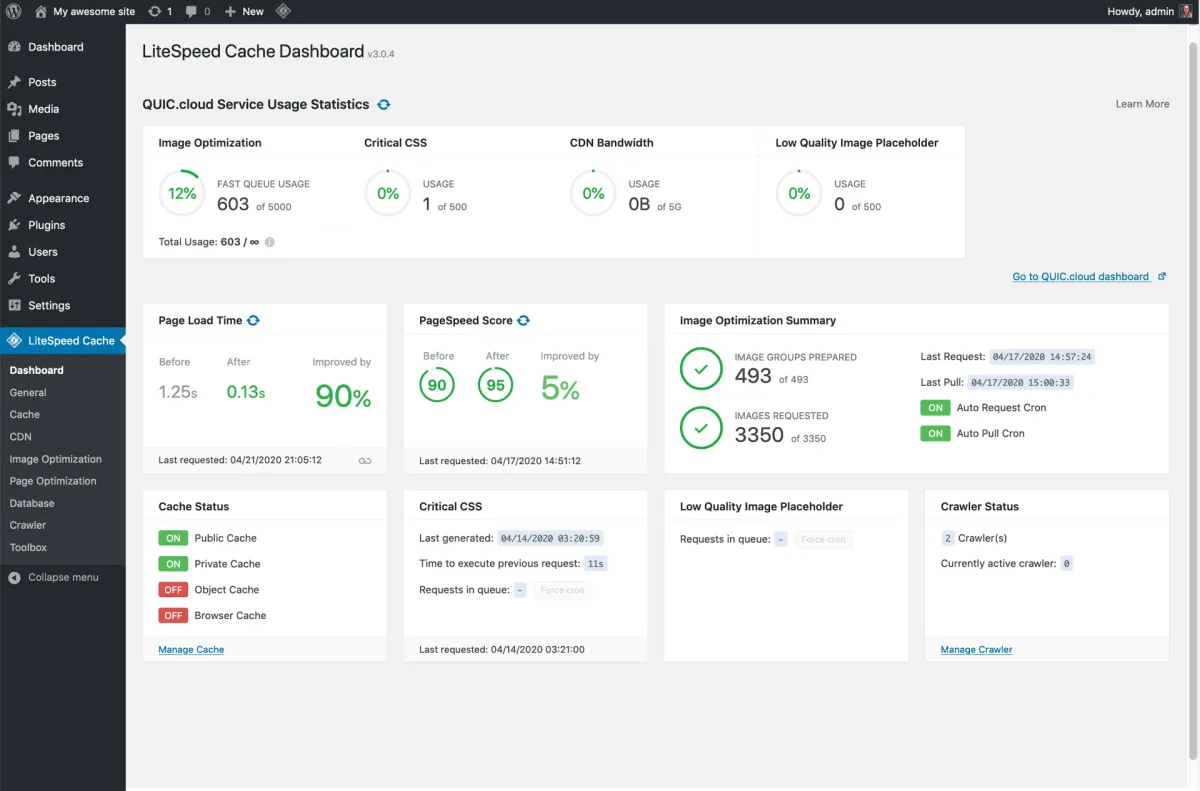
What it is. LiteSpeed Cache (LSCWP) from LiteSpeed Technologies is the most feature-dense free caching and performance plugin in 2026. Inside one plugin you get server-level page caching, object caching (Memcached, LSMCD, Redis), automatic image optimization, lazy load for images and iframes, critical CSS generation, CSS / JS / HTML minify and combine, the free QUIC.cloud CDN, HTTP/3 support, ESI for fragment caching of dynamic content (cart, login state), database cleanup and WebP / AVIF conversion.
Why it earns a top slot. If your hosting runs LiteSpeed or OpenLiteSpeed (most fast-tier shared WordPress hosts in 2026 do, including Hostinger's premium tiers, Namecheap's Stellar plans, A2 Turbo plans, ChemiCloud, and most cloud LiteSpeed configurations), LSCWP gives you actual server-level cache that beats PHP-based caching for raw speed. Even on non-LiteSpeed servers you still get image optimization, minification, lazy loading, critical CSS and the free QUIC.cloud CDN, which is a useful free package on its own.
Free vs paid. Almost everything in LSCWP is free. The "cost" comes from usage-based QUIC.cloud quotas (image optimization, critical CSS generation and CDN bandwidth all have generous free monthly quotas, with paid top-ups if you exceed them). The plugin itself is GPL and remains free forever.
Watch-outs. The settings page is dense, and "enable everything" is rarely the right answer. Start with the recommended preset and add features one at a time, testing each on staging. The image optimization queue is asynchronous and can take a few hours to fully process a large media library.
Best fit. Sites hosted on LiteSpeed / OpenLiteSpeed / QUIC.cloud, WooCommerce stores that need ESI for cart fragments, and anyone who wants one plugin instead of three.
Free download | LiteSpeed Cache project page
3. WP-Optimize: the most useful single plugin for non-LiteSpeed hosts
- WordPress.org: wordpress.org/plugins/wp-optimize/
- Active installs: 1+ million
- Rating: 4.8 / 5 (2,580 reviews)
- Latest version: 4.5.3, released April 29, 2026
- Requires: WordPress 4.9+, PHP 7.2+
- Tested up to: WordPress 7.0
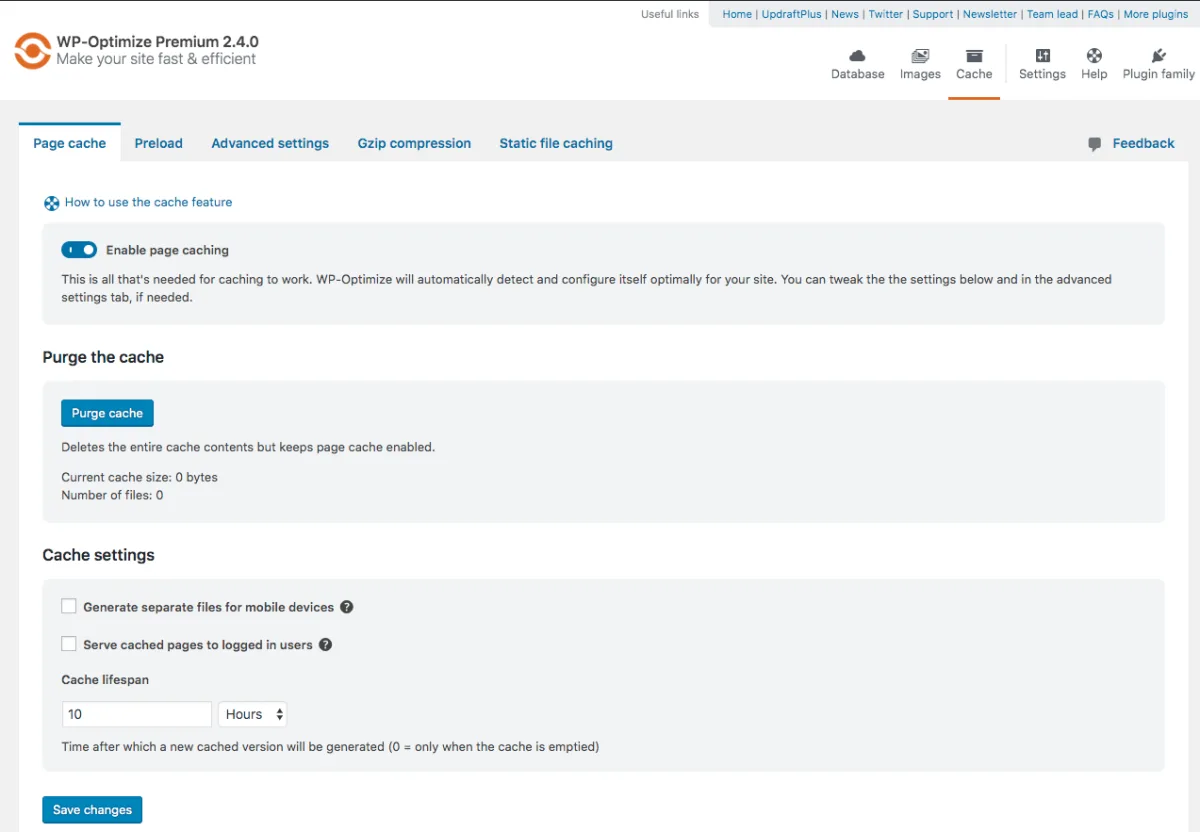
What it is. WP-Optimize from Team Updraft (the team behind UpdraftPlus) is genuinely four tools in one: page caching, image compression, CSS / JS minify and a database cleaner. That makes it the closest free equivalent to "WP Rocket plus Smush plus a database tool", which is the combination most non-LiteSpeed sites used to pay for.
Why it earns a top slot. For sites on Apache / NGINX shared hosting where you cannot use server-level LiteSpeed cache, WP-Optimize gives you 80 percent of the gains in one install. The cache module ships with GZIP, preloading and a sensible default expiry. The image compression module compresses on upload and can run a bulk pass on existing media. The minify module handles HTML, CSS and JS without the manual exclusion lists that W3 Total Cache historically needed. The database module clears revisions, auto-drafts, spam, trashed posts, transients and orphaned meta on a schedule.
Free vs paid. Almost all of what most sites need is in free. WP-Optimize Premium adds multisite support, lazy loading of next-gen images, image conversion to WebP, advanced cache exclusions and priority support. The entry tier sits around $59 per year for two sites in 2026; pricing varies by sites bundle.
Watch-outs. Combining the WP-Optimize cache with another caching plugin will conflict. Pick one cache plugin per site. The database cleaner is powerful; always trigger a backup (UpdraftPlus, BlogVault, or your host's backup) before running the first cleanup.
Best fit. Bloggers, small business sites and agencies that want one plugin to maintain instead of four. Best free pick for sites that do not run LiteSpeed.
Free download | WP-Optimize website
4. W3 Total Cache: still the most configurable free cache
- WordPress.org: wordpress.org/plugins/w3-total-cache/
- Active installs: 900,000+
- Rating: 4.4 / 5 (5,417 reviews)
- Latest version: 2.9.4, released May 19, 2026
- Requires: WordPress 5.3+, PHP 7.2.5+
- Tested up to: WordPress 7.0
What it is. W3 Total Cache (W3TC) is the original "everything in one place" caching framework for WordPress. The free version still includes page cache, object cache, browser cache, database cache, fragment cache, minify, CDN integration (Cloudflare, BunnyCDN, StackPath replacement, KeyCDN and others) and reverse proxy integration (Varnish, NGINX FastCGI). The 2.8 and 2.9 releases under BoldGrid have closed the gap on Core Web Vitals tooling and shipped a friendlier setup guide.
Why it earns a slot in 2026. If you are technical and want explicit, separate cache zones (page, object, database, fragment, browser) and full CDN control, W3 Total Cache still has the deepest free configuration of any caching plugin. It is also the most flexible choice for sites running Memcached, Redis or APCu object caching, because you can pick each engine independently.
Free vs paid. Most of W3TC is free. W3TC Pro adds REST cache, REST fragment caching, REST API caching, fragment caching for logged-in users and extended cache purge controls. Pricing starts around $99 per year per site.
Watch-outs. W3TC is the most powerful and the most dangerous on this list. Wrong combinations break sites. Use the setup guide, start with page cache + browser cache + minify (auto), and only enable object / database cache after you confirm your host supports Redis / Memcached. Avoid combining it with any other cache plugin.
Best fit. Technical users, developers and agency / managed WordPress setups where the engineer wants full control over each cache layer.
Free download | W3 Total Cache website
5. WP Super Cache: simplest reliable cache from Automattic

- WordPress.org: wordpress.org/plugins/wp-super-cache/
- Active installs: 1+ million
- Rating: 4.3 / 5 (1,342 reviews)
- Latest version: 3.1.0, released April 14, 2026
- Requires: WordPress 6.8+, PHP 7.4+
- Tested up to: WordPress 6.9.4
What it is. WP Super Cache is the official caching plugin from Automattic, the company behind WordPress.com. It generates static HTML files from your dynamic WordPress site and serves them to logged-out visitors without running PHP. There are three modes: Expert (mod_rewrite, fastest, requires Apache), Simple (PHP-served, recommended for most users) and WP-Cache (most flexible, slightly slower).
Why it earns a slot in 2026. For a small blog or brochure site on shared hosting that needs caching to "just work" without 30 configuration options, WP Super Cache is the safest free pick. The recommended preset (Simple caching, compress pages, cache rebuild, CDN support, extra homepage checks) covers the typical small WordPress site in two clicks. The 3.1.0 release in April 2026 hardened the plugin, dropped support for PHP 8.0 and below, fixed the wp_die() interaction and bumped the minimum WordPress version to 6.8.
Free vs paid. WP Super Cache is fully free, GPL, and there is no paid tier or upsell. Automattic maintains it as a free utility.
Watch-outs. WP Super Cache focuses on page caching only. It does not minify CSS / JS or optimize images, so you will want to pair it with Autoptimize (next on this list) and Smush or ShortPixel. WP Super Cache also does not include a built-in object cache; if you need that, look at LiteSpeed Cache or W3 Total Cache instead.
Best fit. Small blogs, brochure sites, hobby and nonprofit sites where the priority is "set it once, never think about it again".
Free download | WP Super Cache on GitHub
6. Autoptimize: pair this with any cache plugin

- WordPress.org: wordpress.org/plugins/autoptimize/
- Active installs: 900,000+
- Rating: 4.7 / 5 (1,425 reviews)
- Latest version: 3.1.15.1, released April 4, 2026
- Requires: WordPress 5.3+, PHP 7.1+
- Tested up to: WordPress 6.9.4
What it is. Autoptimize is a focused CSS / JS / HTML optimization plugin. It aggregates and minifies scripts and styles, inlines critical CSS, defers non-critical CSS, moves JavaScript to the footer, removes WordPress core emoji cruft, lazy-loads images (with WebP and AVIF support), optimizes Google Fonts and reduces emoji and WordPress block CSS. It does not include page caching, which is exactly why it complements WP Super Cache, W3 Total Cache or even your host's built-in cache.
Why it earns a slot in 2026. Many free cache plugins ship with basic minification, but Autoptimize remains the cleanest, most-tested option for serious file-level optimization, especially defer-non-critical-CSS and inline-critical-CSS workflows. The plugin is actively maintained, with confirmed compatibility through WordPress 6.9.4 and ongoing security fixes through 3.1.15.1.
Free vs paid. Autoptimize itself is fully free. Autoptimize Pro is an optional add-on subscription that bundles image optimization (powered by ShortPixel), CDN, page caching, automatic critical CSS rules and extra booster options. Pricing on the vendor site sits in the low-single-digit dollars per month range billed annually depending on plan.
Watch-outs. Aggressive aggregation of inline JS or CSS can break page builders (Elementor, Divi, WPBakery). Start with HTML and Google Fonts optimization, then enable CSS minify, then JS minify, testing after each change. Disable "Optimize for logged-in users" if you use a page builder. The 2026 release notes flag this directly and ship with sensible defaults out of the box.
Best fit. Any site that already has a working cache plugin and wants the next tier of CSS / JS optimization without paying for it.
Free download | Autoptimize Pro on AcceleraWP
7. Smush: easiest free image optimizer with no monthly limit
- WordPress.org: wordpress.org/plugins/wp-smushit/
- Active installs: 1+ million
- Rating: 4.8 / 5 (6,039 reviews)
- Latest version: 4.0.3, released April 29, 2026
- Requires: WordPress 6.4+, PHP 7.4+
- Tested up to: WordPress 7.0
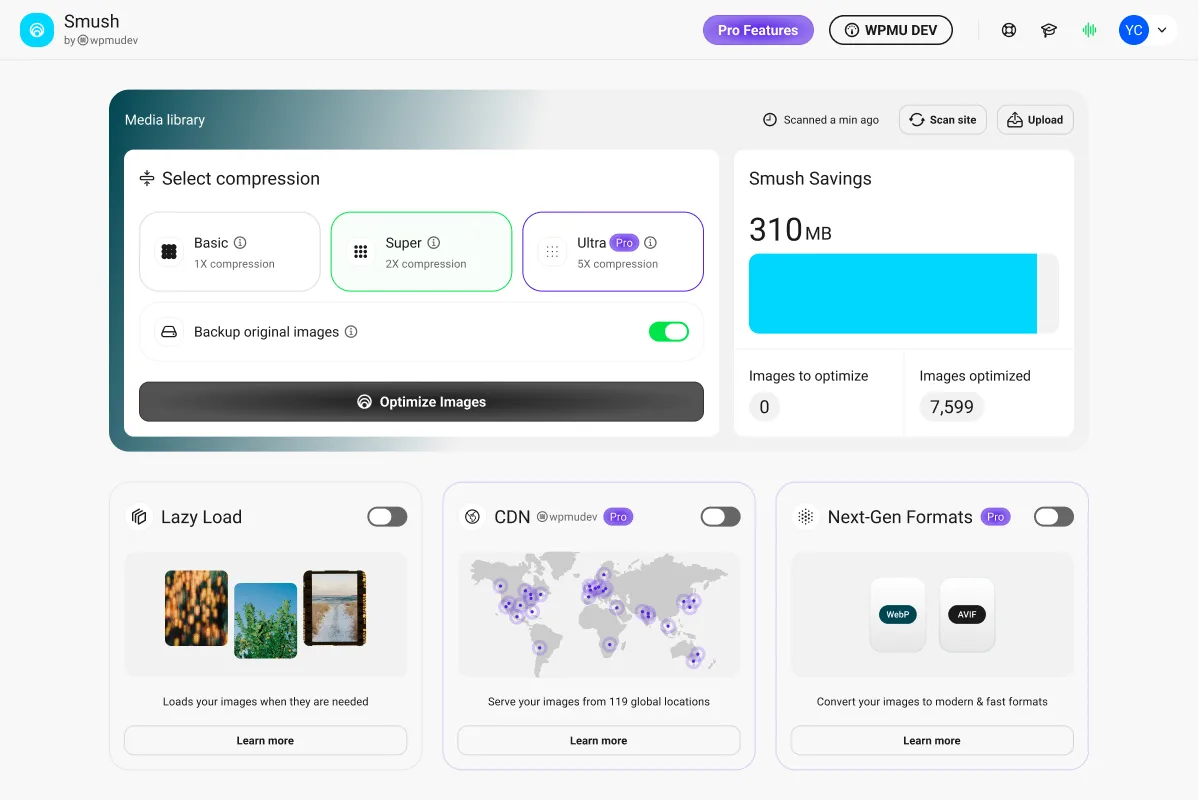
What it is. Smush from WPMU DEV optimizes, compresses, lazy-loads and (in Pro) converts your images to WebP and AVIF. The 4.0 release in April 2026 redesigned the dashboard, removed the old 50-image bulk smush limit in free and added background processing so big media libraries can be optimized while you keep working.
Why it earns a slot in 2026. Smush is the only major free image plugin that does not cap how many images you can compress per month. You can compress your entire media library, lossy or lossless, with no monthly credit. Auto-compress on upload, bulk compression for existing images, lazy load and image resizing are all free. That makes it the simplest free choice for image-heavy sites.
Free vs paid. Free covers lossy / lossless compression for images up to 5 MB, bulk smush, lazy load, Directory Smush (compress images outside the media library) and Super Compression. Pro adds WebP and AVIF conversion, the Smush CDN (119 global servers, up to 500 GB bandwidth), automatic image resizing, image backups and compression for images up to 256 MB. Pro is sold inside a WPMU DEV plan starting at $7.50 per month billed annually, which also bundles other WPMU DEV plugins.
Watch-outs. The free version skips images over 5 MB; resize them before upload or use ShortPixel for the large files. The new 4.0 dashboard adds opt-in toasts and a few promotional surfaces; some 2026 reviewers explicitly complain about the volume of in-admin ads. The compression itself remains solid.
Best fit. Sites that upload many images each week and need an "install and forget" optimizer with no monthly cap.
Free download | Smush product page
8. ShortPixel Image Optimizer: best free image plugin for WebP, AVIF and PDF
- WordPress.org: wordpress.org/plugins/shortpixel-image-optimiser/
- Active installs: 300,000+
- Rating: 4.5 / 5 (813 reviews)
- Latest version: 6.5.1, released May 18, 2026
- Requires: WordPress 4.8+, PHP 7.4+
- Tested up to: WordPress 7.0
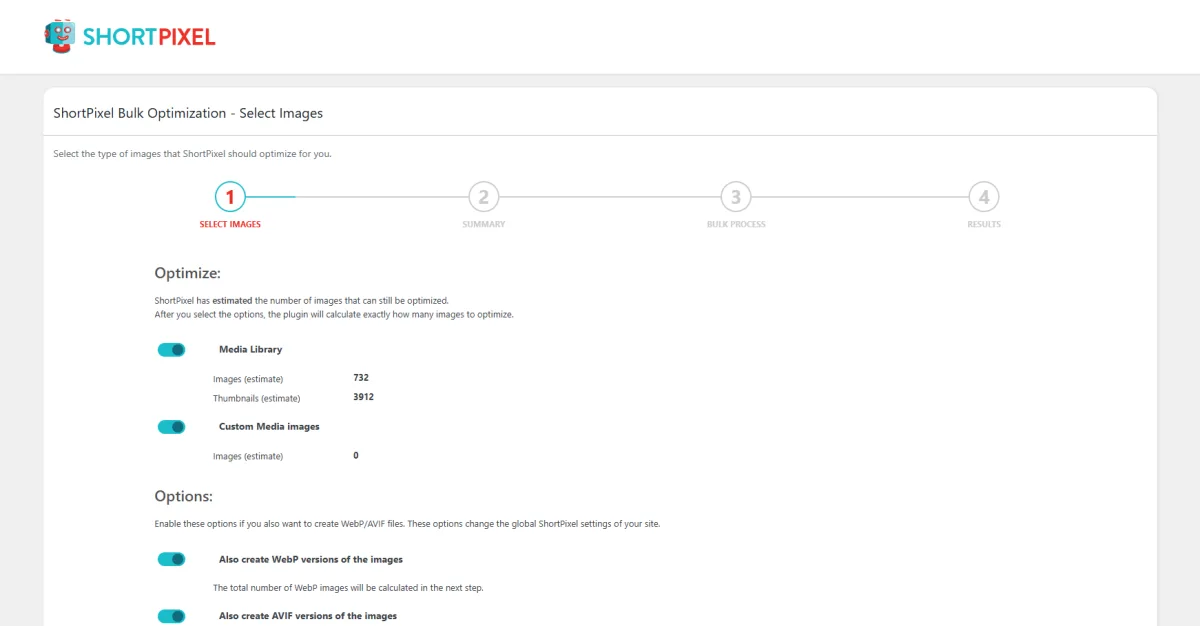
What it is. ShortPixel Image Optimizer is a cloud-based image compression plugin. It compresses JPG, PNG, GIF and WebP, converts to WebP and AVIF, optimizes PDF files and supports retina image versions. Compression happens on ShortPixel's servers via the official API; the plugin pulls the optimized versions back into your media library.
Why it earns a slot alongside Smush. ShortPixel covers what Smush free does not: WebP and AVIF conversion are free at the 100-image per month tier, PDF compression is free and ShortPixel handles images larger than 5 MB out of the box. The free monthly credit (100 image credits per month, refreshing each month) is small but enough for a low-volume blog. The trade-off is that if you upload more than 100 images per month, you need to top up credits.
Free vs paid. Free gives you 100 image credits per month plus WebP / AVIF conversion and PDF support. One-time credit packs start at around $9.99 for 10,000 credits with no expiry, which is the right model for most small sites because credits roll forever. Monthly subscriptions start at around $4.99 for 5,000 credits per month, and unlimited plans (CDN + unlimited optimization) start at around $9.99 per month.
Watch-outs. Because compression is cloud-based, ShortPixel needs the API to reach your site (and your site to upload to the API). If your site is behind a strict firewall, password-protected staging or has hotlink protection, compression will fail until you allow the ShortPixel IPs. Always back up images before bulk compression; ShortPixel supports a backup of originals so you can revert if you don't like the result.
Best fit. Sites that need WebP or AVIF conversion in free, sites with PDFs to compress, photographers and portfolio sites with large source images, and anyone who prefers a credit-based model to a hard 5 MB ceiling.
Free download | ShortPixel website
How to choose: pick one stack, not eight plugins
You do not install all eight of these. You pick one combination based on your hosting and your content type.
If you use Cloudflare Free and want cache plus Cloudflare management in one plugin: install GT Performance. It handles page caching, Cloudflare cache-rule sync, unused CSS removal, and Redis from a single admin. The personal license is free for one site; the commercial license is $199 one-time for up to 25 sites.
If you host on a LiteSpeed / OpenLiteSpeed server: install LiteSpeed Cache. It covers caching, image optimization, minification and CDN in one plugin. Do not install a second cache plugin.
If you host on Apache / NGINX shared hosting (most Bluehost, DreamHost, SiteGround, Hostinger non-LiteSpeed plans): WP-Optimize alone covers cache + minify + image compression + database cleanup. If you need finer image control, swap or supplement with ShortPixel for WebP / AVIF / PDF.
If you want maximum control and your developer set up the site: W3 Total Cache + Autoptimize + Smush or ShortPixel. This is the most powerful free stack but also the most likely to break things if you flip every switch.
If you run a small blog and want zero ongoing maintenance: WP Super Cache + Autoptimize + Smush. Three plugins, recommended presets, done.
If you host with SiteGround: SiteGround Optimizer (SG Optimizer) is the simplest choice because it integrates directly with SiteGround's server-side caching and is free on WordPress.org. It is the only host-specific recommendation worth making in 2026. Outside of SiteGround, it is irrelevant.
If you have already paid for WP Rocket, NitroPack, FlyingPress or Perfmatters: keep them. None of the free plugins above will beat a fully-configured paid all-in-one across every benchmark. The free stack matters when budget is a constraint, not when it isn't.
Whichever stack you pick, do one thing first: run a baseline measurement with PageSpeed Insights and GTmetrix before installing any plugin. Then install, configure, and measure again. If a setting did not measurably help, turn it off. Plugin bloat is the number one cause of "I installed a speed plugin and my site got slower".
Speed work pairs with on-page SEO work. After your stack is stable, walk through our SEO audit checklist to make sure your faster site is also discoverable.
A reminder: no plugin can fix bad hosting. If your TTFB is over 800 ms before any plugin is installed, the bottleneck is your server, not your code. Our WordPress hosting comparison covers the providers that get out of your way in 2026.
FAQ
Which free WordPress caching plugin is the fastest?
For raw measured speed in 2026, GT Performance leads when your site uses Cloudflare Free because it manages the cache rule at the edge and runs exact purges rather than zone flushes. On LiteSpeed / OpenLiteSpeed hosting without Cloudflare, LiteSpeed Cache wins because the cache lives at the server level rather than inside PHP. On non-LiteSpeed, non-Cloudflare hosts the gap closes, and WP-Optimize, W3 Total Cache and WP Super Cache produce similar real-world load times when configured correctly. Caching is the floor; what separates them is configurability, not raw speed.
Can I install more than one caching plugin?
No. Two cache plugins will fight each other for the same files, double-cache HTML, and produce stale pages or 500 errors. Pick one cache plugin (GT Performance, LiteSpeed Cache, WP-Optimize, W3 Total Cache or WP Super Cache) and stick with it. You can safely pair your chosen cache plugin with one image optimizer and one CSS / JS optimizer such as Autoptimize.
Are free plugins as good as WP Rocket or NitroPack in 2026?
For most small and mid-sized sites, yes. The free stack of "LiteSpeed Cache" or "WP-Optimize + Autoptimize + Smush" will get you within five to ten PageSpeed points of a fully-configured WP Rocket setup. The difference is convenience: WP Rocket gives you the same result with three checkboxes; free stacks need a bit more tuning. If your time is worth more than $59 per year, paying for WP Rocket can still be the right call.
What happened to Swift Performance Lite?
Swift Performance Lite is still listed on WordPress.org, but it is effectively unmaintained. The last meaningful release was 2.3.7 in mid-2024, followed by small security fixes in late 2024 and early 2026. Active installs sat around 7,000 in 2026, the rating is 3.6 / 5, and recent reviews flag broken support. We removed it from the 2026 list.
Will these plugins help my Core Web Vitals?
Caching plus minification typically improves LCP (largest contentful paint) noticeably. Image compression plus lazy load helps LCP further when your hero image was previously a 2 MB JPG. Autoptimize's defer JS and inline critical CSS work directly on INP and FCP. None of these plugins fix layout shift (CLS) on their own; that comes from your theme and ad scripts. Together, the right free stack typically moves a site from "Needs Improvement" to "Good" on Core Web Vitals if the hosting is decent.
Do I still need to optimize images manually before upload?
Pre-resizing images to the actual display dimension is still the single most impactful free image optimization you can do, even in 2026. Most "speed" image plugins compress without changing dimensions, which means a 4000 x 3000 px image still ships at 4000 x 3000 px to mobile users. Resize to display width (typically 1200 px wide for content images, 1920 px for full-width banners) using your image editor first, then let Smush or ShortPixel handle compression and WebP / AVIF conversion on upload.
Is SG Optimizer worth installing if I am on SiteGround?
Yes. SG Optimizer is free on WordPress.org and integrates with SiteGround's server-level dynamic and Memcached caching, which you cannot easily replicate with a generic cache plugin. If you host with SiteGround, install SG Optimizer first, then add Autoptimize for CSS / JS and an image optimizer. If you ever leave SiteGround, uninstall SG Optimizer; it no longer has anything useful to do on a non-SiteGround server.
Conclusion
A fast WordPress site in 2026 is still mostly about four boring fixes: cache the HTML, minify CSS and JS, compress images and keep the database clean. Every plugin on this list does at least one of those well, all of them have usable free tiers in 2026, and none of them will block your migration to a different stack later.
If you want one recommendation: install GT Performance if your site runs on Cloudflare (free for one personal site, $199 one-time for commercial). If your host runs LiteSpeed, install LiteSpeed Cache instead. Otherwise install WP-Optimize plus Autoptimize plus Smush. Measure with PageSpeed Insights before and after. Turn off anything that did not move the score. Then go back to writing content, because the second-biggest factor in WordPress speed (after hosting and caching) is not adding a tenth plugin to your stack.
Similar Blogs


