

7 Best WordPress Translation Plugins in 2026 (Free + Paid, Hands-on Tested)


Why translating a WordPress site is harder than it looks (and what a plugin actually solves)
Translating a WordPress site is rarely about copy. It is about routing every page, post, product, menu item, theme string, ACF field, Elementor block, and WooCommerce email through the same translation pipeline, then serving the right language to the right visitor with proper hreflang and indexable URLs. The wrong plugin makes that easy for the homepage and impossible for everything else.
WordPress has no built-in multilingual layer. Translation plugins close that gap in four very different ways:
- Native, database-stored translations. Each translation lives in your WordPress database as a separate post or as a translated string row. You own the data, you keep it after uninstall, your SEO plugin sees it. WPML, Polylang, TranslatePress, and MultilingualPress all sit in this bucket but use very different storage models.
- SaaS proxy. Your content is fetched, translated, and stored on the vendor's servers. The plugin is thin glue. You ship multilingual fast, you pay per word, and your translations leave with you only via export. Weglot is the canonical example.
- Machine-translation widget or proxy. A Google Translate-style switcher that translates rendered HTML on the fly. Free tier is a cosmetic widget with no SEO; paid tier is a real proxy with indexable subdirs or subdomains. GTranslate is the textbook case.
- String-table editor. No translated content, just a .po/.mo editor for the strings that live inside themes and plugins. Loco Translate is the standard.
For the 2026 update of this roundup, I installed every plugin in this list that has a usable free version on a clean WordPress 7.0 sandbox and walked the real admin screens. For the paid-only products (WPML and MultilingualPress 5), I verified pricing and feature scope live on the vendor sites and used vendor-supplied product screenshots where the admin could not be installed without a license. Every claim about pricing, install counts, and version numbers below was verified on 2026-06-15.
My default recommendation for 2026 is WPML: it is the most complete native multilingual stack, the only one that ships first-class WooCommerce Multilingual and Multicurrency, and the one agencies build the most production sites with. If you want a fully free starting point that keeps your translations in your own database, Polylang is the strongest free pick at 800,000+ installs. If you want a visual front-end editor instead of a classic admin list, TranslatePress wins. If you need to ship a multilingual site this week without changing your stack, the Weglot SaaS path exists.
If your site is a WordPress Multisite network, the calculus is different and MultilingualPress 5 is the right pick, not WPML. If you only want to translate the strings inside a plugin or theme without making your site multilingual, the answer is the free Loco Translate, not any of the others.
If your spam, contact, or ecommerce stack also needs attention, our best WordPress contact form plugins and best WooCommerce plugins roundups cover the form and store side of the same multilingual buildout.
How I evaluated each plugin
I checked the same set of buyer-relevant facts for every plugin in the roundup:
- Install reputation. Active installs, average rating, and total review count on WordPress.org as of 2026-06-15. WPML and MultilingualPress 5 do not have public install counts because they are not distributed through wordpress.org.
- Setup speed. How many clicks it takes from "plugin activated" to a working bilingual site, including how friendly the setup wizard is.
- Translation editor. Classic admin lists, visual front-end editor, or external dashboard.
- String translation. Whether the plugin translates theme and plugin strings (gettext) as well as your own content.
- SEO and hreflang. Subdirectory, subdomain, or per-language domain. Whether translated metadata, URLs, and hreflang tags are output cleanly.
- WooCommerce coverage. Whether the plugin handles products, variations, checkout, customer emails, and currency switching.
- AI and machine translation. Which engines (DeepL, Google, OpenAI, Microsoft, AWS) are bundled, and which tier unlocks them.
- Free versus paid line. The exact boundary between the free build and the cheapest paid tier, with the real annual commitment.
- Best fit. The buyer type each plugin really wins for.
Quick comparison table
| Plugin | Best for | Free tier covers | Starting paid plan | Main limitation |
|---|---|---|---|---|
WPML |
Premium gold standard, WooCommerce + agency sites |
No free version |
Multilingual Blog €39/ |
Premium-only, learning curve is real |
Polylang |
Best free native multilingual |
Unlimited languages, classic admin, SEO clean |
Polylang Pro from €99/ |
No machine translation or WooCommerce in free |
TranslatePress |
Best visual front-end editor |
One extra language, 2,000 AI words |
Personal €99/ |
Free capped at one extra language |
Weglot |
Ship multilingual site this week (SaaS) |
2,000 words, 1 language |
Starter €15/ |
Translations live on Weglot servers |
GTranslate |
Budget automatic translation |
Cosmetic widget, no SEO |
Custom $12/ |
Free build does not help SEO at all |
Loco Translate |
Translate plugin and theme strings only |
Full .po/ |
None needed (plugin is free) |
Not a content translation plugin |
MultilingualPress |
WordPress Multisite networks |
No usable free build (legacy v2 retired) |
Starter $149/ |
Requires WordPress Multisite |
1. WPML: the premium gold standard for WooCommerce and agency sites
- Vendor: wpml.org
- Distribution: Premium download from wpml.org (not on WordPress.org)
- Latest version: 4.9.5, released 2026-06-10 (PHP 8.5 compatible)
- Compatibility: WordPress 7.0, Divi 5, Elementor, Gutenberg, WooCommerce
- Vendor reputation: Long-time category leader, OnTheGoSystems team, active 2026 release cadence
WPML is the most complete native multilingual stack in the WordPress ecosystem and the safest pick for any commercial site that does not have a strong reason to choose something else. Every translation is stored in your own WordPress database. Your SEO plugin sees it. Your search index sees it. If you ever cancel the license, your translated content stays.
The 4.9 release stream in 2026 added AI translation cost and time estimates (4.9), Divi 5 plus Elementor compatibility (4.9.1), WordPress 7.0 declared compatibility (4.9.4), and PHP 8.5 support (4.9.5). The "WPML is slow to update" reputation from older comparison articles is no longer accurate.
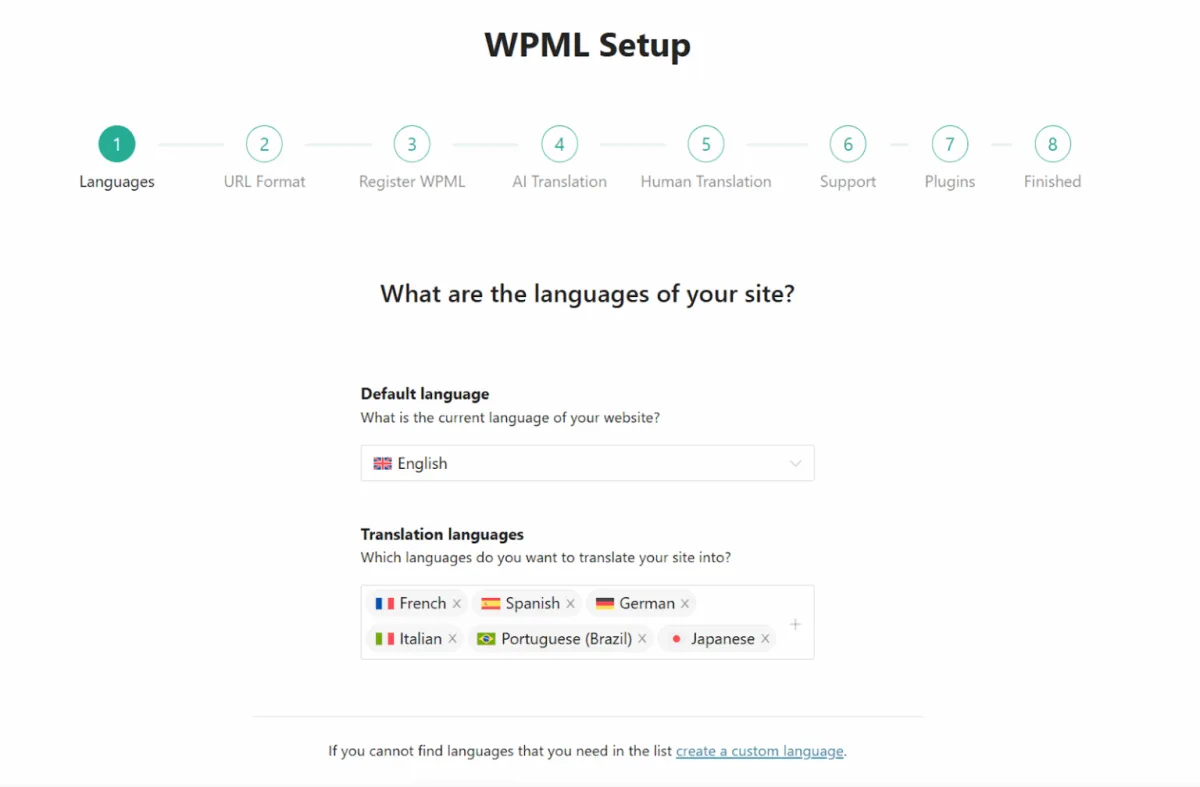
What I verified on 2026-06-15. I walked the live wpml.org purchase, features, AI Translation, and Translation Dashboard pages. The setup wizard screenshot above is the real 8-step onboarding (Languages, URL Format, Register WPML, AI Translation, Human Translation, Support, Plugins, Finished) used by every new WPML install. I confirmed pricing, plan limits, and AI credit allocations directly on wpml.org/purchase. I did not connect a paid license to my sandbox because WPML cannot be installed legitimately without an active license.
Strengths. Translation Dashboard is the only plugin in this list with a true central queue: select content, assign translators or AI, track progress, ship. Advanced Translation Editor is a side-by-side editor with placeholder protection, glossary, and inline AI suggestions. The 4.9 stream now bundles GPT, Gemini, DeepL, and Google through a single AI credits meter, which is materially cheaper than buying credits from each provider separately. String Translation handles any theme or plugin string from any source. Translation Management lets you assign translator users with their own role and only their own work. WPML's WooCommerce Multilingual and Multicurrency module is the most production-tested ecommerce localization stack in WordPress: translated products, variations, attributes, checkout, emails, and per-language currency are all first-class. The features in this paragraph (Advanced Translation Editor, AI Translation, String Translation, Translation Management, Page Builders, Menu translation, WooCommerce, Full Site Editing) all require Multilingual CMS or higher; the entry-level Multilingual Blog tier is intentionally a basic content-translation-only license.
Limitations. Premium-only, no free build. The learning curve is real: the first install is overwhelming if you skip the setup wizard, and the documentation is encyclopedic. Pricing climbs quickly when you add the WooCommerce module or move beyond a single site. Some users on long-running sites report the Translation Management table getting cluttered when an old translator has hundreds of items still queued.
Pricing. All plans verified on wpml.org/purchase on 2026-06-15. Billed yearly.
- Multilingual Blog: €39/year. 1 production site + 3 development sites. Unlimited languages with Standard translation controls (translate content using the WordPress editor). No Advanced Translation Editor, no AI Translation, no String Translation, no Translation Management, no Page Builders support, no Menu translation, no WooCommerce support, no Full Site Editing support. This tier is basic content translation only and is intended for very simple blogs that translate posts manually inside the editor.
- Multilingual CMS: €99/year. 3 production + 9 development sites. Adds Advanced Translation Editor, AI Translation (90,000 credits), String Translation, Translation Management, Page Builders support, Menu translation, WooCommerce support, Full Site Editing support, Multilingual Tools, and Connectors to translation services. This is the realistic starting tier for any non-trivial WPML deployment.
- Multilingual Agency: €199/year. Unlimited sites, 180,000 AI credits, all CMS features. The right pick for agencies and freelancers running more than three client sites.
WPML offers a 30-day money-back guarantee on all paid plans.
Best fit. WooCommerce stores in any language, agency-built sites that need a translator workflow and per-language editorial control, and any site where ownership of the translated content in your own database is non-negotiable.
2. Polylang: the strongest free native multilingual plugin
- Vendor: polylang.pro
- WordPress.org: wordpress.org/plugins/polylang/
- Active installs: 800,000+
- Rating: 4.7 / 5 (2,954 reviews on 2026-06-15)
- Latest version: 3.8.4, released 2026-05-18
- Requires: WordPress 6.2+, PHP 7.4+
- Tested up to: WordPress 7.0
Polylang is the most-installed native multilingual plugin on WordPress.org and the strongest free starting point for any site that wants real translations stored in its own database. Every translation is a separate post linked across the language taxonomy. URLs are clean by default (subdirectory, subdomain, or different domain per language all supported). Yoast and Rank Math are compatible out of the box. If you uninstall Polylang, your translated posts stay in your database as standalone posts, which is the single biggest argument for choosing native over SaaS.
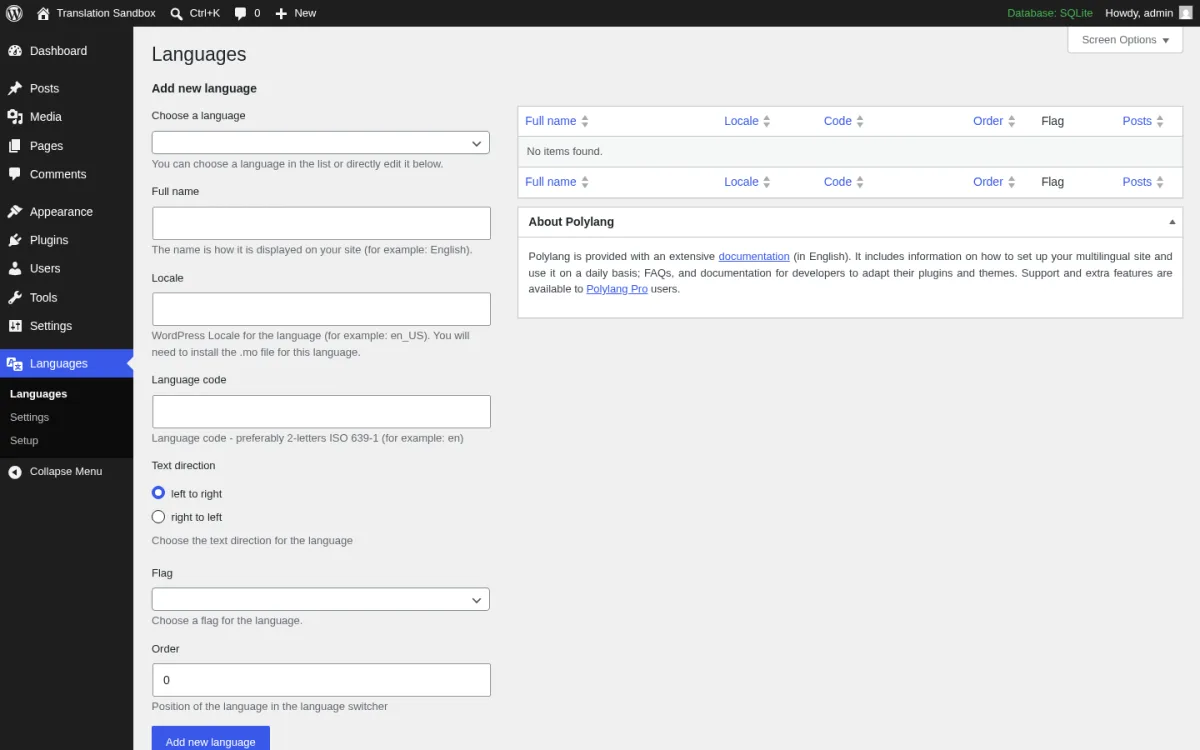
What I tested in a clean WordPress 7.0 sandbox on 2026-06-15. I installed Polylang 3.8.4 from wordpress.org/plugins/polylang, activated it, and opened the Languages admin page at /wp-admin/admin.php?page=mlang. The screenshot above is the real Add new language form (Choose a language drop-down, Full name, Locale, Language code, Text direction, Flag, Order). I confirmed the three setup paths (Languages page, Settings, Setup wizard at ?page=mlang_wizard), and walked the Strings translations panel under Languages > Strings translations. I did not connect Polylang Pro because Pro requires a paid license; I verified Pro features against polylang.pro on the same day.
Strengths. Clean URLs and clean hreflang are the default. Yoast and Rank Math see translated metadata correctly. Lighter than WPML on database queries, which matters on small VPS plans. Pro adds DeepL machine translation (Pro 3.7+), full-site editing template parts, ACF Pro compatibility, capability-based translator roles (added in Pro 3.8, March 2026), and locale fallback for machine translation. Polylang Business Pack bundles Pro plus Polylang for WooCommerce at €139/yr, which is the cheapest credible "Polylang + Woo" stack in the category.
Limitations. Free version has no machine translation, no WooCommerce support, and no first-class page builder integrations. Each translation is its own post, which feels manual if you arrive expecting an automated front-end editor; a one-star review on 2026-05-21 ("literally useless and pointless") is the canonical version of that frustration. Polylang for WooCommerce is a separate add-on, not bundled in Pro by default. ACF integration is in Polylang Pro only.
Pricing. All plans verified on polylang.pro/pricing on 2026-06-15. Prices below exclude VAT.
- Polylang (free): unlimited languages, classic admin translation, string translations, custom post types, RSS feed per language, language switcher widget. No DeepL, no WooCommerce, no Block templates, no translator roles.
- Polylang Pro: from €99/yr (1 site). Adds DeepL machine translation, full-site editing block template translation, ACF Pro compatibility, language switcher block, REST API per language, capability-based translator roles, and email support.
- Polylang for WooCommerce: from €99/yr. Adds WooCommerce product, variation, attribute, and checkout translation. Required if your site is a store.
- Business Pack (Pro + WooCommerce): €139/yr (regular €198). The lowest price for a Polylang stack that handles a WooCommerce store properly.
Best fit. SEO-led teams who want clean URLs and full ownership of translated content, classic WordPress workflows where editors are comfortable with the standard post editor, and budget-conscious sites that want a credible free tier with a clear upgrade path.
3. TranslatePress: the best visual front-end translation editor
- Vendor: translatepress.com
- WordPress.org: wordpress.org/plugins/translatepress-multilingual/
- Active installs: 400,000+
- Rating: 4.7 / 5 (1,638 reviews on 2026-06-15)
- Latest version: 3.2.1, released 2026-06-02
- Requires: WordPress 5.5+, PHP 7.4+
- Tested up to: WordPress 7.0
TranslatePress is the only plugin in this list that translates the rendered HTML of any page using a visual front-end editor, which is what makes it the right pick for non-technical site owners who do not want to manage twin posts in the admin. You translate exactly what you see, in place, with a side-by-side string list on the left. Because the editor sits on top of the rendered HTML, TranslatePress works with any theme, any page builder (Elementor, Divi, Beaver, Bricks, Gutenberg), and any custom field plugin without per-builder integrations.
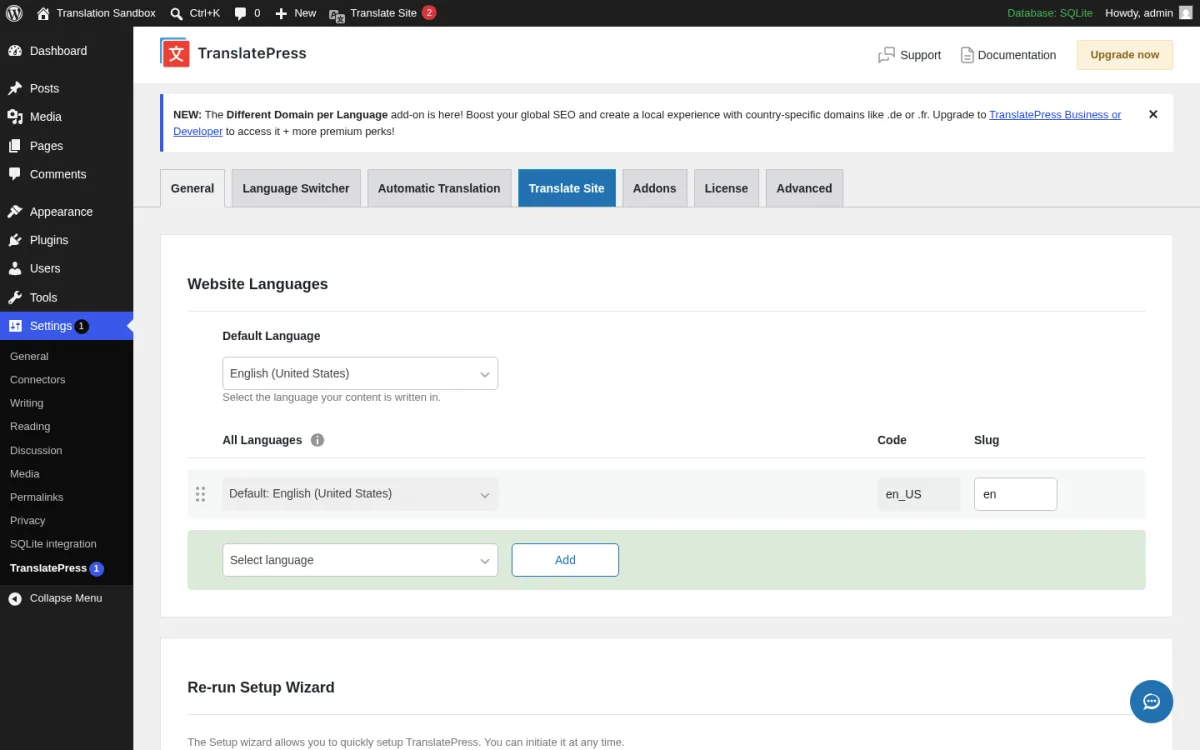
What I tested in a clean WordPress 7.0 sandbox on 2026-06-15. I installed TranslatePress 3.2.1 from wordpress.org/plugins/translatepress-multilingual, activated it, and opened the settings at /wp-admin/options-general.php?page=translate-press. The screenshot above is the real settings page after dismissing the opt-in tracking modal, with the seven-tab strip and the Default Language and All Languages controls visible. I walked the Translate Site front-end editor by clicking "Translate Site" in the admin bar; the front-end editor sidebar loaded with the dynamic string list and a Save Translation button. I confirmed the Re-run Setup Wizard flow at the bottom of the General tab. I did not connect a TranslatePress AI license because the free Translate Site editor + TranslatePress AI Free (2,000 words) was enough to verify the editing flow end to end.
Strengths. Visual front-end editor is the genuine differentiator: you see the page exactly as a visitor sees it, click any text, and translate. TranslatePress AI now bundles GPT, Gemini, DeepL, and Google through a single managed pipeline with no own API keys needed. SEO Pack add-on (Business and Developer) translates meta titles, descriptions, slugs, and OpenGraph correctly. Translator Accounts add-on (Business and Developer) is the cleanest way to hand the front-end editor to a translator without making them an editor. Native WooCommerce support out of the box (free included). The Different Domain per Language add-on supports per-language domains for clean local SEO.
Limitations. The free version is capped at one extra language, which is the friction point reviewers complain about most often. A 2026-06-11 review asked for more AI engine choice in the free tier; the answer right now is that TranslatePress AI Free uses the bundled pipeline and you do not get to swap to your own API key without going Pro. Per-block translation is fine for most sites but very large product catalogues with hundreds of variations may want a "translate everything matching this filter" bulk pass that TranslatePress does not have. SEO Pack is paid only; the free tier alone is not enough for an indexable multilingual launch.
Pricing. All plans verified on translatepress.com/pricing on 2026-06-15. Billed yearly.
- Free: 1 extra language, 2,000 AI words / month via TranslatePress AI Free, manual translation unlimited, WooCommerce, Gutenberg, Elementor support. No SEO Pack, no Translator Accounts, no DeepL add-on, no unlimited languages.
- Personal: €99/year. 1 site, 1 extra language, 50,000 AI words / month, all core features. Cheapest credible paid tier.
- Business: €199/year. 3 sites, unlimited languages, 200,000 AI words / month, SEO Pack, Translator Accounts, DeepL add-on, automatic user language detection, browse-as-other-roles, navigation-based language switching.
- Developer: €349/year. Unlimited sites, 500,000 AI words / month, all add-ons including Different Domain per Language and Multilingual Sitemaps.
Best fit. Non-technical site owners and small agencies who want a visual editor, multilingual blogs and small ecommerce stores that need TranslatePress AI without managing API keys, and any site where the editor is the buyer's biggest objection to going multilingual.
4. Weglot: ship a multilingual WordPress site this week
- Vendor: weglot.com
- WordPress.org: wordpress.org/plugins/weglot/
- Active installs: 60,000+
- Rating: 4.8 / 5 (1,928 reviews on 2026-06-15)
- Latest version: 5.5, released 2026-05-04
- Requires: WordPress 4.5+, PHP 7.4+
- Tested up to: WordPress 6.9.4
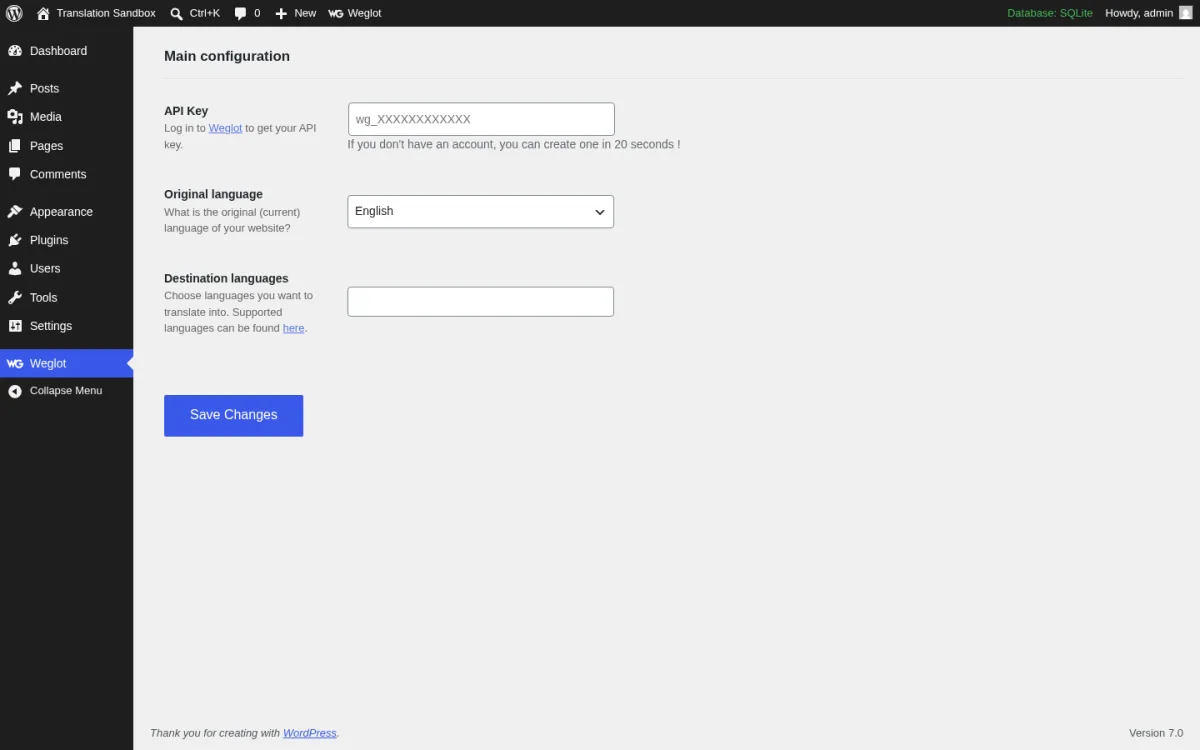
Weglot is the canonical SaaS path to a multilingual WordPress site. The plugin itself is a thin glue layer: you enter an API key, choose an original and destination language, and Weglot starts intercepting your rendered HTML, sending it to its translation engine (DeepL, Google, Microsoft, or a Custom AI Language Model that blends OpenAI and Gemini), storing translations on Weglot servers, and serving translated URLs in subdirectories or subdomains with proper hreflang. There is essentially nothing to configure once you finish the 3-field setup.
What I tested in a clean WordPress 7.0 sandbox on 2026-06-15. I installed Weglot 5.5 from wordpress.org/plugins/weglot, activated it, and opened the settings at /wp-admin/admin.php?page=weglot-settings. The screenshot above is the real Main configuration page with the API Key, Original language, and Destination languages fields. I walked the connection flow up to the API Key entry and confirmed the Weglot Dashboard link target (dashboard.weglot.com). I did not connect a paid Weglot account on the sandbox because the SaaS sign-up requires a domain in the dashboard; pricing, word limits, and engine selection were verified on weglot.com/pricing.
Strengths. Genuinely the fastest path to a multilingual site in this list. Three-field setup, instant translation of every visible page, automatic hreflang, translated metadata, translated URLs (subdirectory by default, subdomain available). Works at the rendered-HTML layer, so it covers Elementor, Divi, Beaver, Gutenberg, and any theme without per-builder modules. Custom AI Language Model is the differentiator in 2026: it blends OpenAI and Gemini with your brand glossary for tone-consistent translation that beats raw DeepL on marketing copy. Vendor backed by Partech (acquired 2023). Review stream is overwhelmingly positive.
Limitations. Translations live on Weglot servers, not your database. Export is supported but flagged by some reviewers as a "request support" path rather than a self-service download, so factor that into your offboarding plan. Cost climbs fast on content-heavy sites: a 200,000-word marketing site on the Pro tier costs €79/month / €948/year, which is more than two years of WPML Multilingual CMS. The free 2,000-word allowance is a demo, not a serious starting point. The plugin reports Tested up to WordPress 6.9.4, which lags WP 7.0 by one cycle; not a red flag but worth a note.
Pricing. All plans verified on weglot.com/pricing on 2026-06-15. Billed monthly or yearly.
- Free: 1 site, 1 destination language, 2,000 words. Useful only for a demo.
- Starter: €15/month (€150/year). 1 site, 1 language, 10,000 words. Smallest plan with credible word allowance.
- Business: €29/month (€290/year). 1 site, 3 languages, 50,000 words.
- Pro: €79/month (€790/year). 1 site, 5 languages, 200,000 words. The pricing-sweet-spot for marketing sites.
- Advanced: €299/month (€2,990/year). 10 languages, 1,000,000 words.
- Extended: €699/month (€6,990/year). 20 languages, 5,000,000 words.
- Enterprise: custom.
Best fit. Marketing-led teams that need a multilingual site live this week with minimum developer involvement, and that are comfortable paying a recurring SaaS bill that scales with their content. Not the right pick if your offboarding plan requires translations to stay in your WordPress database.
5. GTranslate: budget automatic translation (paid tier required for SEO)
- Vendor: gtranslate.io
- WordPress.org: wordpress.org/plugins/gtranslate/
- Active installs: 900,000+
- Rating: 4.9 / 5 (4,908 reviews on 2026-06-15)
- Latest version: 3.1.1, released 2026-06-05
- Tested up to: WordPress 7.0
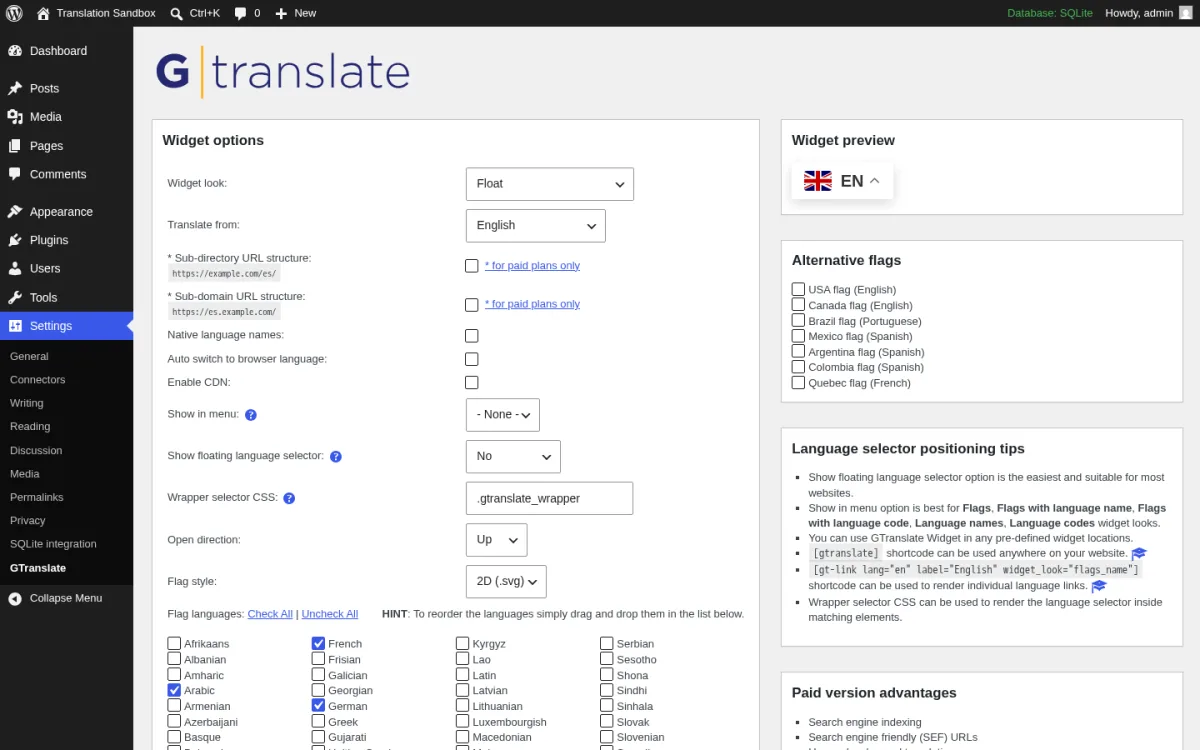
GTranslate has 900,000+ active installs because the free widget is genuinely zero-setup: you activate the plugin, drag a language switcher widget into a sidebar, and visitors can use Google Translate on your site without leaving it. The trap is that the free version is a client-side Google Translate widget. It does not create translated URLs, it does not output hreflang, and it does not help you rank in any other language. Buyers install it, see "we have translations now," and discover months later that they have no organic traffic in those other languages. Plan around this.
The paid GTranslate tiers ($12/mo and up) are a real product: server-side neural translation, indexable translated URLs (subdirectory or subdomain), per-language hreflang, sitemap support, and in-context editing for the engine's output.
What I tested in a clean WordPress 7.0 sandbox on 2026-06-15. I installed GTranslate 3.1.1 from wordpress.org/plugins/gtranslate, activated it, and opened the settings at /wp-admin/options-general.php?page=gtranslate_options. The screenshot above is the real Options page with Widget options on the left (Widget look set to Float), the live Preview on the right, the Paid version advantages card describing the upgrade, the Alternative flags card, and the Flag languages checkbox grid with all 56 Google Translate languages preselected. I confirmed that the free build only injects the floating client-side switcher; no server-side translated URLs are created on the free tier.
Strengths. The cheapest credible paid plan in this category (Custom $12/month covers a single bilingual site with neural translation and indexable URLs). Server-side translation on paid tiers means crawlers see translated HTML at translated URLs. 56+ languages out of the box, including Chinese Traditional, Hindi, Filipino, Yiddish, and right-to-left languages. Image translation and analytics are bundled at the Business tier ($35/month) and up. Strong review stream (4.9 from 4,908 reviews) reflects the free widget being a happy default for small sites that do not care about SEO.
Limitations. The free build helps zero with SEO, full stop. URL translation, the feature that actually drives multilingual organic traffic, is locked to the Business tier ($35/month / $350/year). The translation engine is automatic only: you cannot hand-edit translations on the free tier, and even on paid tiers the in-context editor is a Google-style post-hoc fix rather than a primary editor. Translations live on GTranslate servers (similar to Weglot), which means offboarding is the same trade-off.
Pricing. All plans verified on gtranslate.io/#pricing on 2026-06-15.
- Free widget: $0. Client-side Google Translate widget, no SEO benefit. Useful as a courtesy switcher only.
- Custom: $12/month ($120/year). 1 website, bilingual or all languages, neural translation, hosted on
your-domain.gtranslate.io/lang/subdomain. - Startup: $25/month ($250/year). Multilingual subdirectories on your domain, all languages, in-context editing, hreflang.
- Business: $35/month ($350/year). Adds URL translation (indexable translated URLs in any language), translation proxy, image translation.
- Enterprise: $50/month ($500/year). Adds priority support, more dynamic content handling.
Best fit. Budget-conscious sites that want broad language coverage on a tight budget and understand that the free tier is cosmetic. Pick the Custom or Startup tier from day one if you want any SEO value at all.
6. Loco Translate: the free .po editor for plugin and theme strings
- Vendor: localise.biz
- WordPress.org: wordpress.org/plugins/loco-translate/
- Active installs: 1,000,000+
- Rating: 4.8 / 5 (449 reviews on 2026-06-15)
- Latest version: 2.8.5, released 2026-06-01
- Requires: PHP 7.4+
- Tested up to: WordPress 7.0
Loco Translate is the only plugin in this list that is not a content translation plugin. It is a .po/.mo editor that lives inside the WordPress admin. If you ever needed to change a phrase like "Add to cart" to "Buy now" without touching the plugin's source code, or translate a niche plugin's UI strings into a language the developer never shipped, Loco is the answer.
The plugin is 100% free, has no Pro tier, and asks for no account. It is the de facto standard for the job: 1,000,000+ active installs and one of the cleanest editors in any plugin admin. If your translation problem is content (posts, products, menus), Loco is the wrong tool. If your translation problem is interface strings, every other plugin in this list is the wrong tool.
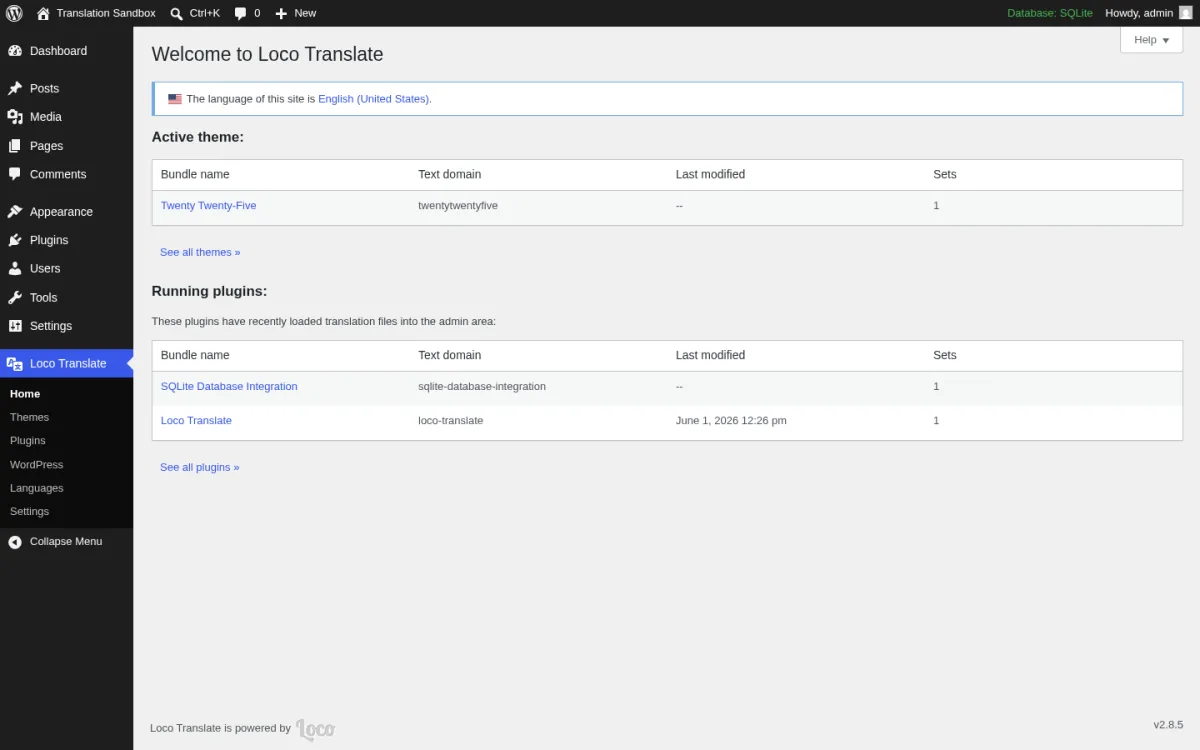
What I tested in a clean WordPress 7.0 sandbox on 2026-06-15. I installed Loco Translate 2.8.5 from wordpress.org/plugins/loco-translate, activated it, and opened the Welcome page at /wp-admin/admin.php?page=loco. The screenshot above is the real welcome dashboard listing the active Twenty Twenty-Five theme and the loaded plugin gettext domains (SQLite Database Integration and Loco Translate itself). I walked the Themes editor by clicking into Twenty Twenty-Five and confirmed the bundle metadata, the Add new language flow, and the side-by-side translation editor at ?page=loco-theme&action=poedit. I did not exercise the Loco hosted translation service at localise.biz because that is a separate paid product outside the plugin itself.
Strengths. Pure-free, no upsell, no API key, no account. Edits any .po/.mo file in wp-content/languages/ or any plugin or theme's /languages/ folder, with conflict-safe storage in a separate wp-content/languages/loco/ directory so plugin updates do not overwrite your custom translations. Built-in PO file editor with translation memory, fuzzy matching, source-string filtering, and a "save to MO" toggle. Optional integration with the Loco hosted translation service at localise.biz for collaborative translation projects.
Limitations. Not a content translation plugin. If you install it expecting your blog posts to appear in another language, you will be confused. No language switcher, no front-end translated URLs, no hreflang. Useful only for translating the interface strings of WordPress core, themes, and other plugins.
Pricing. None. The Loco Translate plugin is free and will remain free. The Loco hosted service at localise.biz has separate paid plans for teams that want a remote translation memory and translator collaboration, but the plugin works fully on its own without ever signing up.
Best fit. Developers and site owners who want to translate plugin or theme UI strings, or override an awkward stock phrase without forking the plugin. Pair it with one of the content translation plugins above for any site that needs translated posts or products.
7. MultilingualPress: best for WordPress Multisite networks
- Vendor: multilingualpress.org
- Distribution: Premium download from multilingualpress.org (maintained by Syde GmbH, formerly Inpsyde)
- Latest version: 5.1.1, released 2026-04-08
- Requires: WordPress Multisite
- WordPress.org legacy listing: The free v2 plugin on wordpress.org/plugins/multilingual-press is retired and is not the current product
MultilingualPress is the only plugin in this list that is built natively on top of WordPress Multisite. Each language is its own site in your Multisite network. Posts, products, and any other content type are linked across sites through the MLP "Translations" UI on each post. The architectural payoff is huge for editorial networks: each language can have a different content strategy, different editors, different plugin stack, and different theme. WPML, Polylang, and TranslatePress all force you to keep one site that holds every language. MLP lets you genuinely separate them.
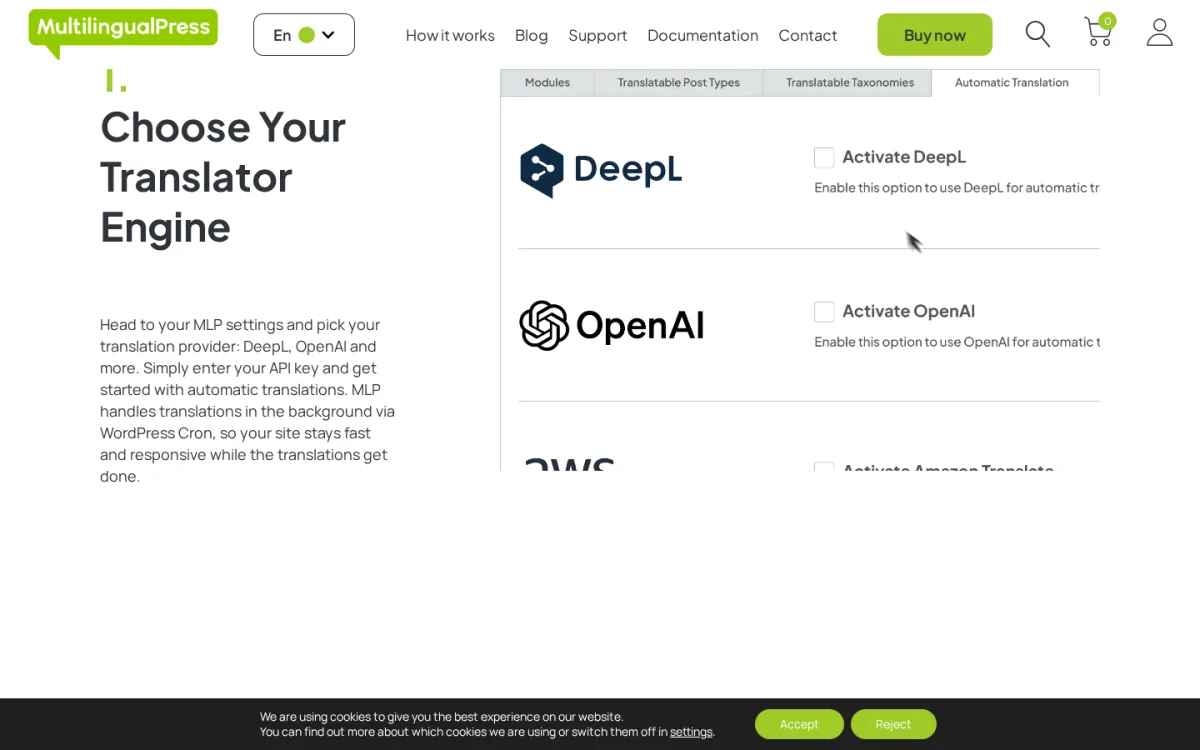
What I verified on 2026-06-15. MultilingualPress 5 is premium-only and requires a paid license to install legitimately, so I did not install it in the WordPress 7.0 single-site sandbox. I read the multilingualpress.org product, how-it-works, pricing, and changelog pages, plus the MLP 5.0 launch announcement (which introduced AutoTranslate with DeepL and OpenAI). The vendor screenshot above shows the real "Choose Your Translator Engine" settings panel from the product, with the DeepL, OpenAI, and AWS toggles that you wire up by entering an API key.
Strengths. Each language is a standalone WP site, which means full editorial separation, separate roles, separate plugins per language, and separate themes per language. Yoast SEO officially recommends MultilingualPress for Multisite-based multilingual sites. WooCommerce-compatible out of the box (each store is a separate WooCommerce install with its own products, currencies, and gateways). AutoTranslate (added in 5.0) covers DeepL, OpenAI, and AWS via API keys you bring. Translations are stored in your own database (per-site). Per-language hreflang and indexable URLs are automatic. Documented WP VIP partnership signals enterprise-grade stewardship.
Limitations. Multisite required. If your site is not already Multisite, MLP is a major infrastructure step rather than a drop-in plugin. The single-site WordPress shop that just wants a French version is not the right buyer here; WPML or Polylang are. The legacy v2 free plugin on wordpress.org is retired and should not be installed for a 2026 launch.
Pricing. All plans verified on multilingualpress.org on 2026-06-15. Billed yearly.
- Starter: $149/year. 1 Multisite install, 2 languages, AutoTranslate via DeepL or OpenAI (you supply the API key).
- Professional: $499/year. 6 languages, all AutoTranslate engines.
- Advanced: $899/year. 12 languages.
- Enterprise: $1,499/year. Unlimited languages, priority support.
Best fit. Publishers, enterprise sites, agency networks, and ecommerce groups that already run WordPress Multisite, or that have a strong reason to separate languages into independent sites (separate editors per language, separate WooCommerce stores per country, separate plugin stacks per market). Skip if your site is single-site WordPress.
How to choose your WordPress translation plugin
The first decision is architectural: native database storage or SaaS proxy?
- Pick native (WPML, Polylang, TranslatePress, MultilingualPress) if you want translations to live in your own WordPress database. You own the data, your SEO plugin sees it, and offboarding the translation plugin leaves the translated content behind in your database.
- Pick SaaS proxy (Weglot, paid GTranslate) if shipping a multilingual site this week with minimum developer time matters more than long-term data ownership.
The second decision is the editor.
- Pick TranslatePress if a visual front-end editor is the buyer's biggest objection.
- Pick WPML if you need a translator workflow with assigned users, a queue, and a credit-metered AI translation pipeline.
- Pick Polylang if you are SEO-led and want clean URLs, classic admin lists, and the lightest possible plugin footprint.
The third decision is WooCommerce.
- Pick WPML for the most production-tested WooCommerce multilingual stack (WPML WooCommerce Multilingual and Multicurrency is the gold standard).
- Pick Polylang Business Pack (€139/year) for the cheapest credible Polylang + WooCommerce path.
- Pick TranslatePress for a WooCommerce site that wants the visual editor and is fine with TranslatePress' WooCommerce integration (free, included).
The fourth decision is Multisite.
- If your site is already Multisite, MultilingualPress is the right answer; the other plugins all assume a single-site install.
The fifth decision is "I only need to translate plugin/theme strings."
- If that is your real requirement, Loco Translate is the answer and the rest of this list does not apply. The other plugins all translate content; only Loco edits .po files.
For the typical case ("I have a small business WordPress site and I want it in two or three languages"), the realistic top three are WPML (premium, complete), Polylang (free + Pro, native), and TranslatePress (visual editor). Try the free TranslatePress build first; if you outgrow the single extra language cap, upgrade to TranslatePress Personal or move to Polylang or WPML based on whether classic admin lists or a translator workflow matters more to you.
If you are still planning the multilingual launch, our guide to the best types of websites to build in WordPress covers the site model first; the translation stack is downstream of the model. For WooCommerce stores specifically, pair the choice above with our guide to setting up a WooCommerce store.
FAQ
Which WordPress translation plugin is best for SEO?
For SEO, native plugins win. WPML, Polylang, TranslatePress, and MultilingualPress all store translations in your database and output indexable translated URLs with proper hreflang on default settings. Among the three single-site native plugins, Polylang has the cleanest hreflang implementation out of the box, WPML has the most production-tested SEO integrations, and TranslatePress requires the SEO Pack add-on (Business and Developer tiers) to translate meta titles, descriptions, slugs, and OpenGraph correctly. The GTranslate free widget is the worst SEO choice in this category; paid GTranslate tiers (Custom $12/month and up) fix that but you have to pay.
Is there a really free WordPress translation plugin?
Yes, three of them: Polylang (free version, unlimited languages, classic admin, but no machine translation and no WooCommerce), TranslatePress (free version, one extra language, 2,000 AI words a month, visual editor, free WooCommerce), and Loco Translate (free forever, but only for plugin and theme string translation, not site content). Weglot and GTranslate have technically free tiers that are demo-only. WPML and MultilingualPress 5 have no free version.
Can I switch translation plugins later without losing translations?
You can if you started with a native plugin (WPML, Polylang, TranslatePress, MultilingualPress). Native plugins store translations as standard WordPress posts and meta, so the translated content survives even after you deactivate the plugin. You will lose the linking between languages but the content stays. You cannot easily migrate from a SaaS proxy (Weglot, paid GTranslate) because the translations live on the vendor's servers. Both vendors support an export, but switching is a real migration project rather than a click.
How does AI translation work in WordPress in 2026?
Every plugin in this list now bundles AI translation, but the metering differs. WPML uses an "AI credits" allowance per plan and routes credits across GPT, Gemini, DeepL, and Google through one pipeline. TranslatePress AI bundles GPT, Gemini, DeepL, and Google through a single managed pipeline and meters in words per month. Weglot supports DeepL, Google, Microsoft, and a Custom AI Language Model (OpenAI + Gemini) on every paid tier. Polylang Pro supports DeepL only and requires your own DeepL API key. MultilingualPress 5 supports DeepL, OpenAI, and AWS via API keys you bring. GTranslate uses its own neural engine on paid tiers and Google Translate on the free widget. For most marketing sites the practical pick in 2026 is whichever plugin lets you avoid managing API keys yourself: WPML and TranslatePress AI both clear that bar.
What is the difference between WPML, Polylang, and TranslatePress?
WPML is premium-only, uses classic admin lists with an Advanced Translation Editor and a translator workflow, and has the most complete WooCommerce stack. Polylang has a strong free version, uses classic admin lists with separate posts per language, has the cleanest free hreflang and SEO behavior, and requires a paid add-on for WooCommerce. TranslatePress has a strong free version (capped at one extra language), uses a visual front-end editor that translates rendered HTML, and includes WooCommerce support out of the box. For a non-technical buyer, TranslatePress is usually the friendliest start. For an agency or store, WPML's stack pays back its premium cost.
Do I need a multilingual plugin if my site already uses subdomains for each language?
If you manually run separate WordPress installs on subdomains (en.example.com, fr.example.com) you do not need a multilingual plugin to display the content, but you will pay for that in editorial overhead and broken cross-language linking. If your team is comfortable running independent WordPress installs and you want true editorial separation per language, the right product is MultilingualPress on top of WordPress Multisite rather than three separate installs. If you want one editor managing one site that publishes in three languages, you want WPML, Polylang, or TranslatePress, not separate installs.
Will any of these plugins translate WooCommerce checkout and emails?
WPML's WooCommerce Multilingual and Multicurrency module translates products, variations, attributes, categories, tags, checkout flow, customer emails, and per-language currency. TranslatePress supports WooCommerce in the free build (products, checkout flow, customer emails) but currency switching is not included. Polylang for WooCommerce (paid add-on) translates products, variations, attributes, taxonomies, and customer emails; multicurrency is handled by separate plugins like CURCY. Weglot translates everything visible including checkout and customer emails. GTranslate paid tiers translate the rendered checkout pages. MultilingualPress treats each language as a separate WooCommerce install. For most stores, WPML or Polylang Business Pack is the safest pick.
The right WordPress translation plugin for 2026
If you only remember three things from this roundup:
- WPML is the safest premium pick for any commercial WordPress site that needs WooCommerce, a translator workflow, and AI translation with proper credit metering. Multilingual CMS at €99/year is the realistic starting tier.
- Polylang is the strongest free starting point for sites that want native storage and clean SEO. The Polylang Business Pack (€139/year) gives you Polylang Pro + Polylang for WooCommerce as the cheapest credible "Polylang + Woo" stack.
- TranslatePress is the friendliest editor and the right pick when a non-technical site owner wants to translate exactly what they see on the front end. The free build (one extra language, 2,000 AI words) is enough to validate the approach before paying.
If you are running WordPress Multisite, MultilingualPress 5 is the only plugin built for that architecture, so pick it even if WPML pricing looks closer. If your problem is plugin or theme UI strings rather than content, Loco Translate is the answer and you can stop reading. If you want a SaaS shortcut and are comfortable paying recurring, Weglot is the cleanest path. If your budget is tight and you understand the SEO trade-off, paid GTranslate (Custom or Startup) covers automatic translation cheaper than any other option in this category.
For more must-have multilingual building blocks, see our top free WordPress plugins roundup, and if your forms also need to live in multiple languages, pair your translation choice with the best WordPress contact form plugins.
Similar Blogs


