

7 Best WordPress Menu Plugins for 2026 (Mega, Mobile, Sticky)


The default WordPress menu is fine for a brochure site with five links. The moment you add product categories, a docs hub, a multi-step service tree, or a mobile experience that needs to feel like an app, the built-in nav starts to creak. That is when a dedicated menu plugin earns its keep.
For this 2026 refresh I shortlisted 12 plugins from the WordPress.org repository and the top mega-menu listicles ranking right now, then narrowed the list to 7. For every finalist I cross-checked the WordPress.org plugin page (version, install count, rating, last update, "tested up to" version), the vendor's live pricing page, the changelog of the most recent year, and the public live demo where one exists, then captured a clean screenshot from each demo so you can see what the plugin actually outputs on a real site. Where Pro is the realistic path, the annual cost is called out with the billing term.
The list covers four common needs: a mega menu with widgets and grids, a polished mobile/hamburger experience, a sticky header utility, and a context-aware sidebar/section menu for docs and large content sites.
How I evaluated these plugins
- Maintenance signal: last update date in 2025 or 2026, no "not tested with latest 3 major WordPress releases" warning on WordPress.org.
- Adoption signal: active install count and current star rating on WordPress.org.
- Free-version usefulness: can a real site ship core navigation without buying Pro?
- UX clarity: how quickly a non-developer can convert a vanilla WP menu into a usable mega/mobile menu, based on the vendor's documented setup flow and the public demo.
- Pricing fairness: exact current price for a one-site licence and the next sensible tier, with billing term.
- Fit: what kind of site this plugin actually solves the problem for.
Two plugins from the previous version of this article did not make the 2026 cut. Groovy Menu (Free) was closed by WordPress.org on October 17, 2025 for a licensing/trademark violation and is no longer available for download. WP Mega Menu by Themeum has not received an update in roughly 5 years and now carries the "not tested with the latest 3 major releases" warning. I would not recommend installing either today.
Quick comparison
| Plugin | Best for | Free version | Starting paid price | Strongest point |
|---|---|---|---|---|
Max Mega Menu | Drop-in mega/ | Yes, generous | $29/ | Cleanest free build in the category |
Responsive Menu | Mobile/ | Yes | $49/ | 150+ free style options |
WP Mobile Menu | Slide-out mobile nav for any theme | Yes | $6.99/ | Easiest to ship as a mobile-only overlay |
ElementsKit | Elementor sites needing header + mega menu | Yes (Lite) | $39/ | Header builder + mega menu in one addon pack |
QuadMenu | Theme-builder mega menus and offcanvas | Yes | $49/ | Multiple layout modes (offcanvas, vertical, tabs) |
WP Sticky (Sticky Menu & Sticky Header) | Making an existing header stick on scroll | Yes | $39 one-time (1 site, launch 50% off) | Works without touching theme code |
Advanced Sidebar Menu | Auto sidebar nav for docs and big content sites | Yes | $74/ | Hierarchical menu that updates itself |
1. Max Mega Menu: best free mega menu for most WordPress sites
Max Mega Menu is still the safest starting point for anyone whose first question is "how do I turn this basic WordPress menu into a real mega menu?" The plugin converts an existing menu created in Appearance > Menus into a mega menu in a couple of clicks, and the free version is unusually capable.
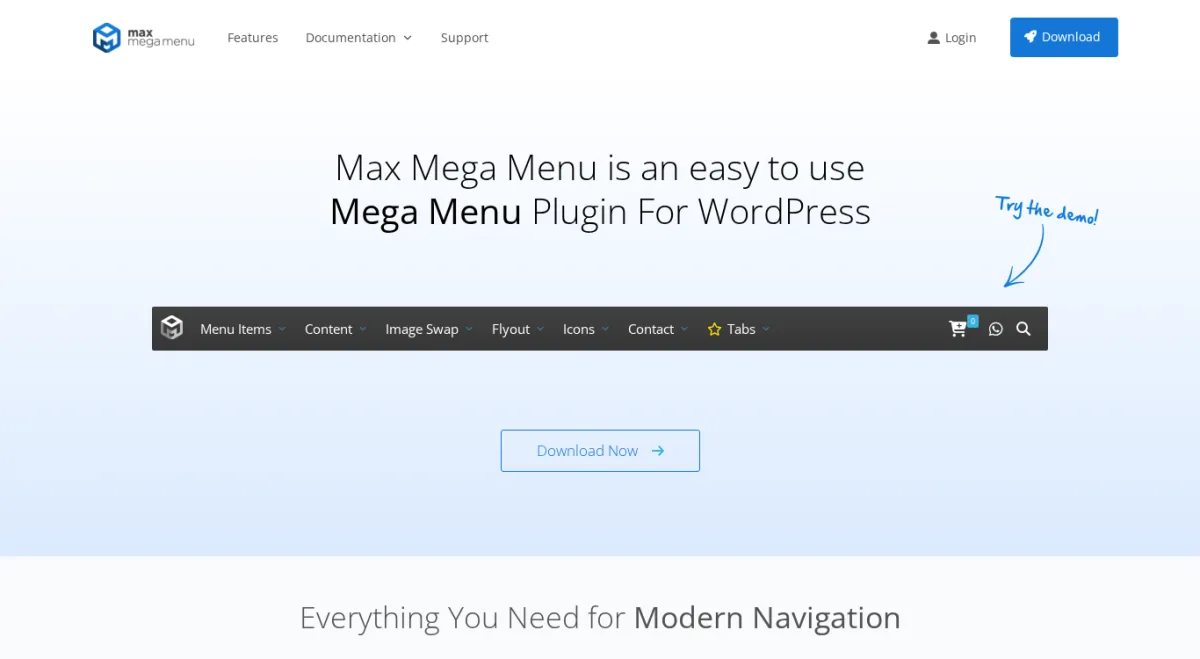
What I verified for 2026: latest version 3.9.2.1, last updated within the last month on WordPress.org, tested up to WordPress 7.0, 300,000+ active installs, 4.8 stars across 869 reviews. The changelog shows steady accessibility, admin UX, and PHP-compatibility work through 2025-2026 (notably the 3.9 admin refactor and the off-canvas/keyboard-navigation improvements in 3.8 and 3.4). I also opened the official live demo at megamenu.com and clicked through the Mega Menu, Flyout, Icons, Tabs and Cart variations to confirm that the documented behaviour matches what the plugin actually outputs on the page (icons in menu items, badge/cart support, search field, multi-column grid sub-menus).
What you get free
- Convert any existing WP menu to a mega menu, no theme changes.
- Grid Layout builder so each sub-menu becomes a row/column grid.
- WordPress widgets and Gutenberg blocks inside menu items.
- Off-canvas (slide-in) or standard drop-down mobile menus.
- Built-in theme editor for colours, fonts, spacing.
- Hover, hover-intent or click triggers; fade/slide transitions.
- Single static CSS file, sub-2KB gzipped JS, full keyboard navigation.
- Dedicated Gutenberg block and Elementor widget.
Free-version limits
- No tabbed mega menus, no vertical/accordion menus.
- No built-in logo, search box, WooCommerce/EDD cart, or Font Awesome/Genericon icon picker.
- Sticky header is Pro-only.
Pricing summary (annual, billed once per year)
- Personal: $29/year for 1 site.
- Business: $49/year for 5 sites.
- Developer: $99/year for 99 sites (lifetime updates, 12 months of support).
Who it is for: any WordPress site where the existing nav already lives in Appearance > Menus and you simply want a clean upgrade to mega/mobile behaviour without committing to a new page builder. If you only ever need the basics, you can ship on the free build indefinitely.
2. Responsive Menu: most customisable mobile menu in the free tier
Responsive Menu by ExpressTech is built around one job: replacing the default mobile menu on any theme with a fully styled hamburger experience, with as little CSS as possible. The free version exposes more than 150 options (the vendor claims 22,500 combinations) covering colours, fonts, animations, button position, screen-size breakpoints, custom HTML, WPML/Polylang and RTL.
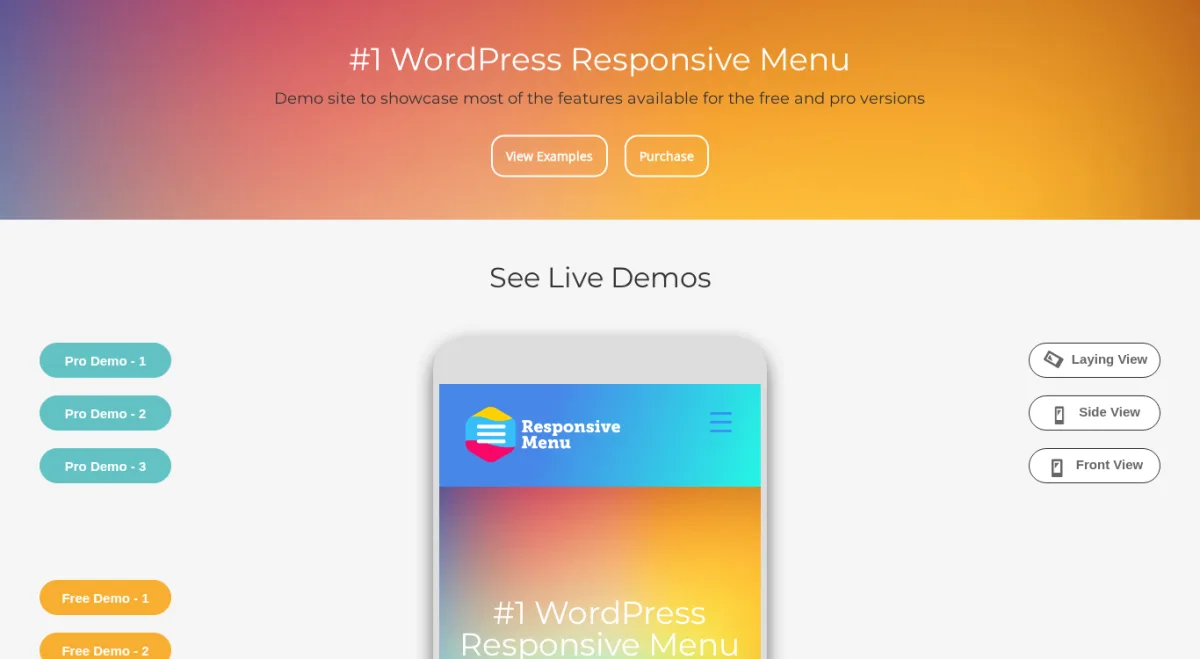
What I verified for 2026: version 4.7.2 shipped on May 20, 2026, 80,000+ active installs, 4.5 stars across 569 reviews. The recent changelog shows a steady drumbeat of security patches, accessibility (tab navigation, parent active class), and feature work (logged-in/logged-out item visibility, social icon block inside the menu, dark-mode customizer). I opened the public demo at demo.responsive.menu, walked through the free demo and three of the pro demos, and the layered "Laying / Side / Front" preview tabs let you compare how the same hamburger menu renders across viewports without leaving the demo page.
What you get free
- Slide-over or push-content menu, from any side (left, right, top, bottom).
- Custom breakpoint so the menu only activates below a chosen width.
- Integrated search, logo upload, custom HTML blocks inside the menu.
- Per-item visibility for logged-in and logged-out users.
- Import/export of settings, WPML/Polylang and RTL out of the box.
- Live customizer-style preview while editing.
- Tab/keyboard navigation for accessibility.
Free-version limits
- No animated menu items, no FontIcon picker for individual items.
- No 15-button animation pack, no colour opacity controls, no integrated header bar.
- Mega-menu/desktop replacement features are Pro.
Pricing summary (annual)
- Essential: $49/year, 1 site.
- Advanced: $79/year, up to 5 sites.
- Expert: $95/year, up to 100 sites.
Who it is for: sites where the theme's mobile menu is the actual problem (or simply ugly) and you want to swap in something modern without touching code. The free tier is genuinely enough for most one-site owners.
3. WP Mobile Menu: quickest mobile-only overlay
WP Mobile Menu takes a narrower approach than Responsive Menu: it focuses almost entirely on the mobile-screen experience and ships an opinionated slide-out panel that activates below your chosen breakpoint while the desktop theme menu stays untouched.
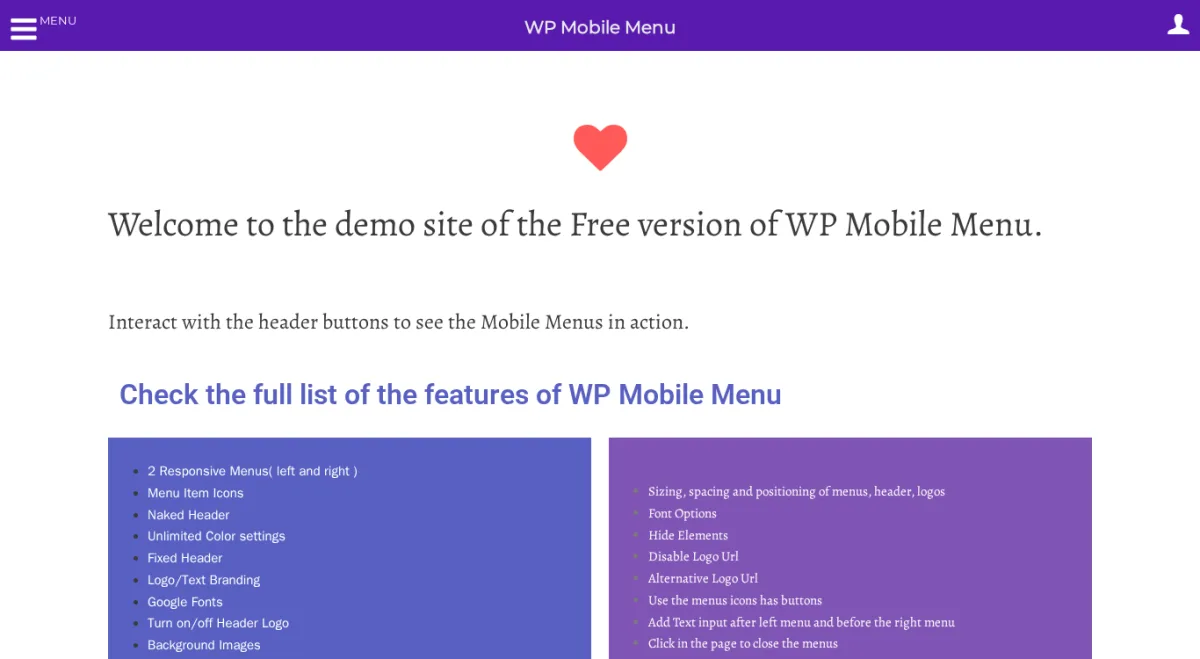
What I verified for 2026: version 2.8.8, around 80,000+ active installs, 4.7 stars across 256 reviews. The honest yellow flag here is the update cadence: the latest plugin release on WordPress.org is roughly 11 months old at the time of writing, although it still works on current WordPress 6.x. Worth watching, but not a deal-breaker if you only need the documented features. The official free-version demo at demo.wpmobilemenu.com mirrors the admin flow advertised in the readme (hamburger toggle on the top-left, profile icon on the top-right, slide-over panel below the breakpoint), and the public feature list confirms which capabilities sit behind Premium.
What you get free
- Slide-out from left or right, plus push-content or slide-over display modes.
- Up to 3 menu depth levels.
- Logo or text branding in the header, plus a "naked header" mode.
- Background image, Google Fonts, overlay mask when the menu is open.
- Auto-hide your theme's own mobile menu while the plugin's panel is active.
Free-version limits
- No live header search, no footer menu, no per-page/per-role menu rules.
- No Font Awesome/Fontelicon/Iconic icon pack, no animated icons, no 5th-level submenus.
- WooCommerce cart icon, sliding cart, and product filter are Premium Ecommerce only.
Pricing summary (monthly billing on the vendor pricing page; vendor mentions up to 33% off annual upfront)
- Professional: $6.99/month for 1 site.
- Business (WooCommerce): $9.99/month for 5 sites.
- Enterprise: $39.99/month for 25 sites.
Who it is for: sites where the desktop nav is fine but the mobile experience needs a clean, opinionated overlay quickly. Pair it with a desktop-only theme menu and the free version is enough to ship.
4. ElementsKit: best pick if your site already runs on Elementor
If you build with Elementor, installing a separate mega-menu plugin often duplicates settings you already control inside the page builder. ElementsKit Lite by Wpmet solves that by bundling a header/footer builder, a mega-menu builder, custom widgets, and an extra widget pack into one Elementor addon.
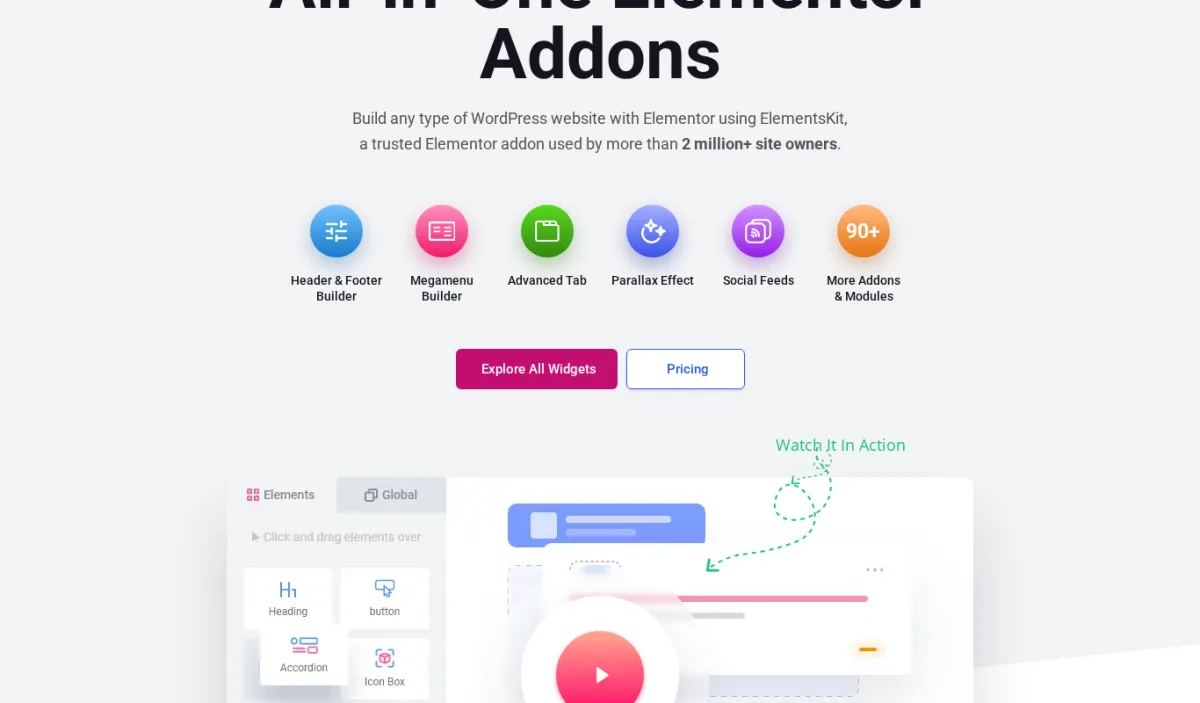
What I verified for 2026: the Lite version is in the 2M+ active install range on the vendor side and is updated regularly (latest readme update in May 2026). The plugin advertises 110+ widgets and 1000+ templates in the wider ecosystem, but the menu story specifically lives in the header-footer builder and the dedicated mega-menu module. I opened the vendor's Elements / Header-Footer page and the Megamenu Builder module is one of the six headline modules on the homepage, with the documented drag-and-drop UI confirmed against the vendor's product video and Elementor docs.
What you get free
- Drag-and-drop header and footer builder for Elementor.
- Mega-menu builder that uses Elementor widgets and templates inside sub-panels.
- Sticky content and one-page scroll modules.
- Solid widget pack for content, posts, social, basic WooCommerce.
- 20+ modules you can toggle on/off depending on the build.
Free-version limits
- Many decorative widgets, parallax controls, and advanced design presets are Pro.
- Custom-built widget builder, advanced WooCommerce widgets, and template kits sit behind Pro.
- Header conditions and global cross-domain copy/paste are Pro.
Pricing summary
- Annual: $39/year for 1 site, $87/year for 5 sites, $179/year for unlimited sites (current discounted prices on the pricing page).
- Lifetime: $119 one-time for 1 site, $259 for 5 sites, $489 for unlimited.
Who it is for: Elementor users who want a single addon to handle header layout and mega menus instead of stacking a mega-menu plugin on top of a separate header builder. Skip it if you do not use Elementor. If you are still deciding which Elementor toolkit to pair this with, our roundup of the best Elementor addons for WordPress covers the wider addon landscape.
5. QuadMenu: mega menu with multiple layout modes
QuadMenu by QuadLayers is a quieter alternative to Max Mega Menu, with a stronger focus on layout variety. Out of the box it offers offcanvas mobile, vertical desktop menus, sidebar menus, and a drag-and-drop admin that extends the standard Appearance > Menus screen.
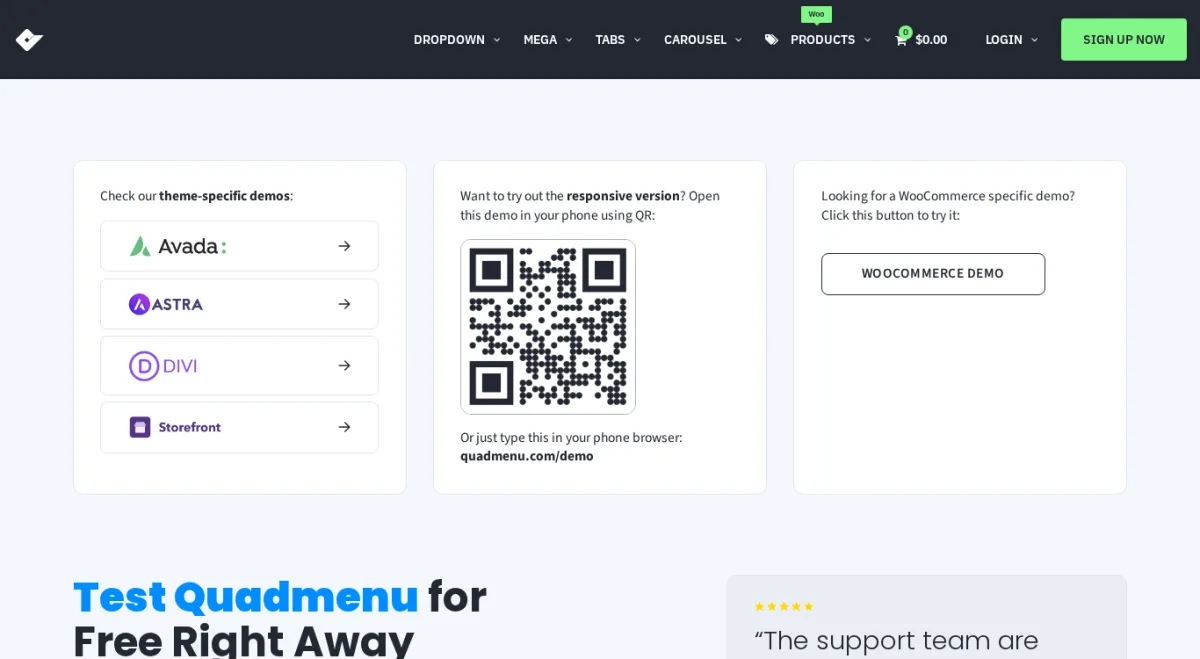
What I verified for 2026: version 3.3.4 shipped in May 2026, 10,000+ active installs, 4.5 stars across 267 reviews. Smaller install base than the giants, but still actively maintained with recent compatibility, security, and dependency updates. The official Corporate demo at quadmenu.com/demo-corporate exposes the four documented top-level layouts (Dropdown, Mega, Tabs, Carousel) and a Products mega-menu, plus theme-specific demos for Avada, Astra, Divi and Storefront so you can sanity-check how it lands on your stack.
What you get free
- Automatic and manual menu integration with the WP menu system.
- Drag-and-drop admin builder, multiple menu locations.
- Display widgets in menu, support for child themes and unlimited menu themes.
- Vertical, horizontal and offcanvas mega-menu layouts.
- Sticky menu, hover-intent triggers, Font Awesome icons, Google Fonts.
- Cart menu and search menu items, screen-size visibility per item.
Free-version limits
- Tabs menu, login menu, register menu, social menu and carousel menu items are Pro.
- Customizer integration for live theming is Pro.
- Some users in WordPress.org reviews report slower support replies on Pro; weigh that if you need fast vendor turnaround.
Pricing summary (USD)
- Personal: $49/year or $129 lifetime for 1 site.
- Agency: $99/year or $199 lifetime for 5 sites.
- Developer: $149/year or $299 lifetime for unlimited sites.
Who it is for: sites that need offcanvas/vertical mega menus rather than just a wider dropdown, and teams that want a lifetime option without buying into a full page-builder ecosystem.
6. Sticky Menu & Sticky Header: make any element stick on scroll
Sometimes the menu itself is fine and the only missing piece is "keep this header visible while the user scrolls." Sticky Menu & Sticky Header by WebFactory, formerly known as Sticky Menu (Or Anything!) On Scroll, does exactly that without forcing you to rebuild the header.
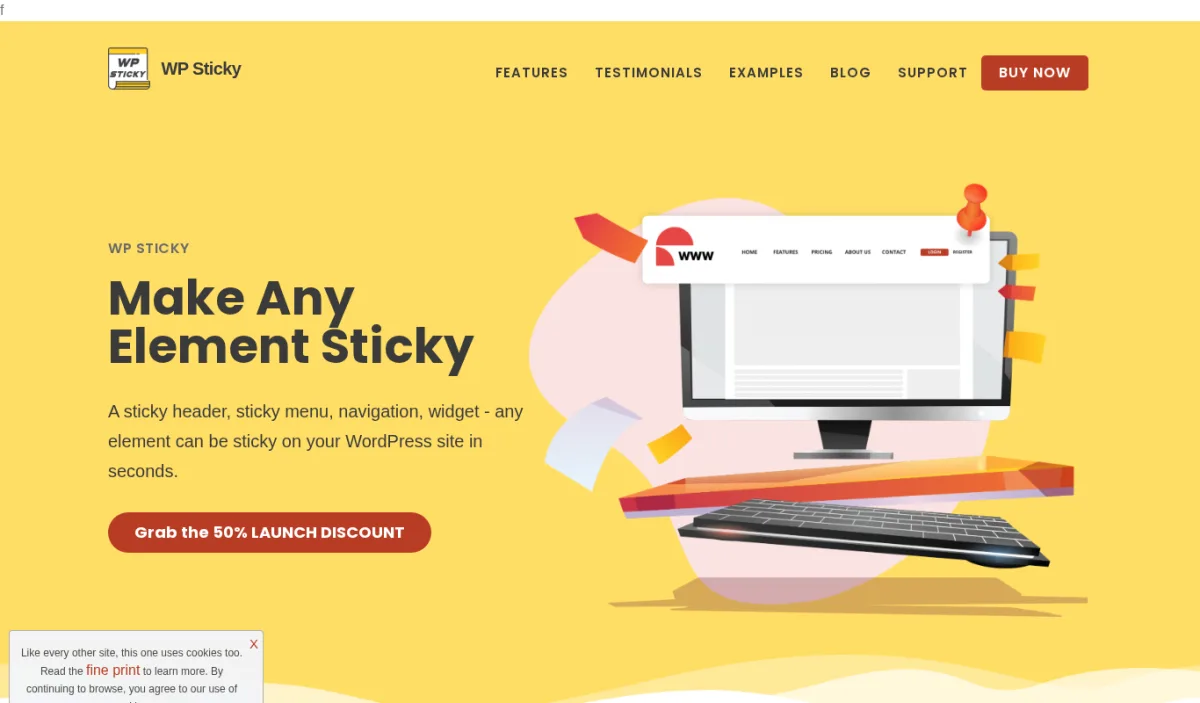
What I verified for 2026: version 2.35, around 100,000+ active installs, 4.7 stars across 759 reviews, tested up to WordPress 7.0. Update cadence is slower than the menu-builder plugins in this list (minor releases roughly once a year), but it remains compatible and is mainly there to keep an existing solution running. The vendor's own marketing site at wpsticky.com uses the plugin on its own sticky header, so you can scroll the page and watch the behaviour the free plugin produces (header stays at the top, no jump on transition, admin-bar aware).
What you get free
- Make any CSS selector sticky on scroll: header, nav, widget, banner, CTA.
- Optional top offset, so the sticky element does not jam against the viewport edge.
- Min/max screen-size limits, so you can disable stickiness on mobile if it gets in the way.
- Z-index control, push-up element for sidebars, admin-bar aware.
- Debug mode that surfaces selector problems in the browser console.
Free-version limits
- Only one element can be sticky at a time (multiple-element sticky is Pro).
- Visual element picker (no CSS knowledge) is Pro.
- Per-post/per-category exclusions are Pro.
Pricing summary (one-time lifetime licences; vendor is currently running a 50% launch discount, prices below reflect that discount)
- Single: $39 one-time for 1 site (regular $49). Also available as $5.99/month.
- Team: $49 one-time for 3 sites (regular $79).
- Agency: $99 one-time for 100 sites (regular $199).
- All paid plans include lifetime updates, unlimited sticky elements, the visual element picker, and white-label mode.
Who it is for: teams that already like their menu but want it (or the logo, or a CTA) to stay visible while the visitor scrolls. Picking the right CSS selector is the only real skill required.
7. Advanced Sidebar Menu: auto-updating sidebar nav for docs and big content sites
Advanced Sidebar Menu by Mat Lipe plays a different role than the others. Instead of replacing the header, it builds a sidebar (or in-content) menu that automatically reflects where the visitor is in your page/category hierarchy. For documentation sites, knowledge bases, or large blogs with deep category trees, this is the cleanest way to avoid hand-maintaining "section" menus.
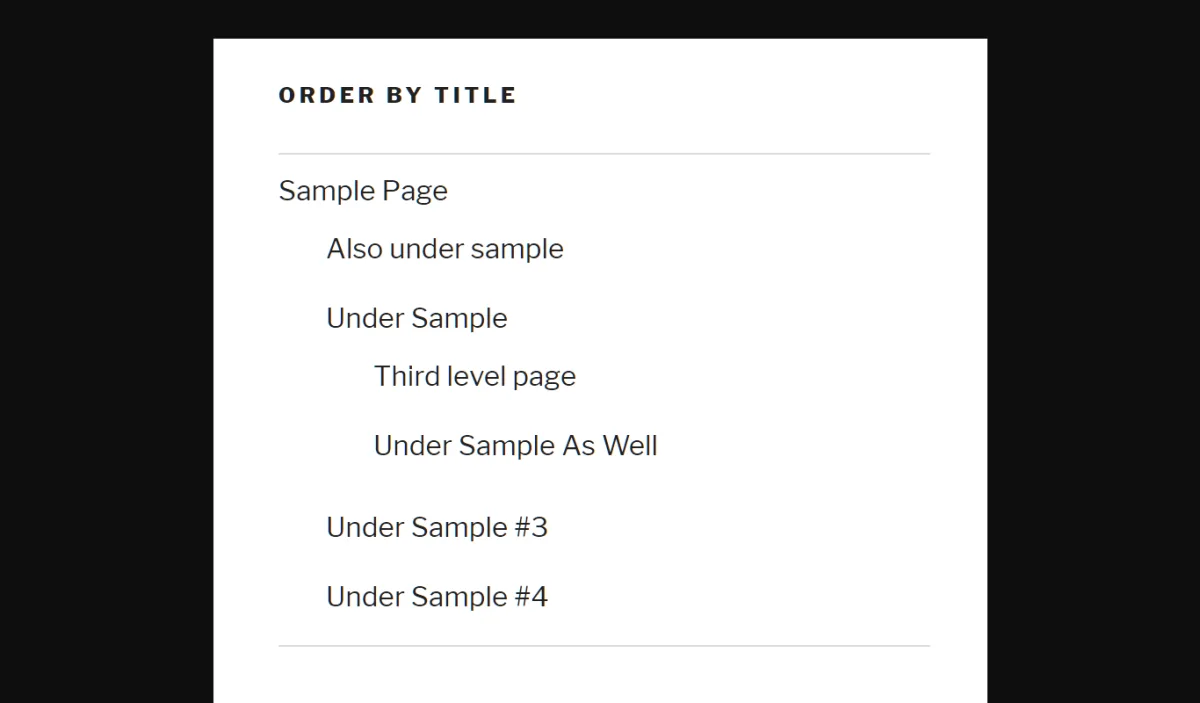
What I verified for 2026: version 9.8.4, updated within the last few days at the time of writing, 10,000+ active installs, 4.5 stars across 37 reviews, tested up to WordPress 7.0 with PHP 7.4+. The codebase has been steadily modernised (Gutenberg blocks, classic widget fallback, Beaver Builder and Elementor support). The wordpress.org plugin page also ships a "Live Preview" button that boots a real Playground sandbox so you can drop the block on a page and see the live hierarchy output without installing anything; the screenshot below is the actual block output (page hierarchy ordered by title) from the published plugin assets.
What you get free
- "Advanced Sidebar - Pages" and "Advanced Sidebar - Categories" Gutenberg blocks.
- Equivalent classic widgets for page-builder and theme-customizer sidebars.
- Auto menu that shows the current page, its parent, grandparent and child pages (or categories).
- Order by date/title/menu order, exclude items by ID, choose how many levels to display.
- Optional display of categories on single posts.
Free-version limits
- No styling controls (colours, hover, font weight, borders) inside the block; you style with theme CSS.
- Custom post types and custom taxonomies are Pro.
- Accordion behaviour, navigation-menu widget, and "show only current page's parents and children" mode are Pro.
Pricing summary (unlimited sites on every paid tier)
- Basic: Free forever, unlimited sites, core blocks and widgets.
- PRO Yearly: $74/year, unlimited sites, all PRO features, updates and priority support.
- PRO Lifetime: $187 one-time, unlimited sites, lifetime PRO updates and priority support.
Who it is for: documentation sites, multi-section content sites, and sidebar-heavy blogs that need the menu to stay in sync with the content tree without manual upkeep. Skip it if your nav lives only in the header.
How to choose between them
A short decision tree based on real use cases I have seen:
- You just want a normal site nav to gain mega/mobile features: Max Mega Menu, free.
- The desktop is fine but mobile is the actual problem: Responsive Menu if you need maximum styling control, or WP Mobile Menu if you want the fastest mobile-only overlay.
- Your site is built in Elementor: ElementsKit Lite, so the header and mega menu live in the same toolchain.
- You need offcanvas, vertical or sidebar mega menus rather than a wider dropdown: QuadMenu.
- The menu works, you just want it to stick on scroll: Sticky Menu & Sticky Header.
- You run a docs site or a big content site and need section-aware sidebar menus: Advanced Sidebar Menu.
Every plugin in this list keeps the existing menu structure (the WP Appearance > Menus items) and only styles or extends it, so the swap is reversible. You can deactivate any of them and fall back to the default theme menu.
FAQ
Do I need a menu plugin if my WordPress theme already has a "mega menu" feature?
Usually no. Modern themes from established builders (Astra, Kadence, Blocksy, Divi, GeneratePress Premium) ship usable mega-menu and mobile-menu controls. Install a dedicated plugin only when the theme's controls cannot do what you need (grid sub-menus, widgets inside menus, offcanvas mobile, sticky-on-scroll, etc.) or when you are switching themes and want the navigation to be theme-independent.
Will these plugins slow my site down?
The mega-menu and sticky plugins in this list are reasonably lightweight by design: Max Mega Menu, for example, ships under 2KB of gzipped JS plus a single static CSS file. The riskier additions are the page-builder addon packs (ElementsKit), because they load more than just the menu module. Activate only the modules you actually use.
Is the free version of Max Mega Menu enough?
For most one-site owners, yes. The free build covers grid mega menus, off-canvas mobile, widgets inside menus, accessibility, and a working theme editor. You only need Pro for sticky menus, tabbed/vertical menus, the logo/search add-on, WooCommerce/EDD integration, or the icon picker.
Are these plugins compatible with Gutenberg and full-site editing themes?
Max Mega Menu, ElementsKit, QuadMenu and Advanced Sidebar Menu all ship Gutenberg blocks. Max Mega Menu specifically restores the Appearance > Menus screen on FSE themes, which is helpful if your block theme has hidden it.
What is the safest pick if I do not want to pay anything in 2026?
Max Mega Menu plus Sticky Menu & Sticky Header. Both have a healthy install base, an active 2026 maintenance signal, and free tiers that cover real production navigation work.
Why are Groovy Menu and WP Mega Menu (Themeum) no longer in this list?
Groovy Menu Free was closed by WordPress.org on October 17, 2025 for a licensing/trademark violation. WP Mega Menu by Themeum has not been updated in roughly 5 years and now carries the "not tested with the latest 3 major releases" warning. Neither is a safe install in 2026.
Final pick
If you only want one recommendation: install Max Mega Menu free. It is the most balanced option in this category, the maintenance signal is the strongest in the list, and you can upgrade only when you need sticky headers, tabbed mega menus or a search/logo addon. For mobile-only overhauls, Responsive Menu is the strongest free option. Elementor sites should default to ElementsKit Lite instead of stacking another mega-menu plugin on top.
Similar Blogs


